

Fig.1.
Sol LeWitt
Key Observations
- Trying to separate the concept, the idea from the aesthetics
- The production process as the idea
- Appearance of the work as secondary to the idea
- Emphasising art as an object, making it easier to ascribe a value to it
- Removing the focus on the materiality of the object, to focus on the idea
- Object creation is the responsibility of others, removes the artist from the act of production
- The others are responsible for the critical decision making
- Questions the importance of the artist in the creation of an idea and object that is valuable
- The inherent quality of the work varies according to the ‘installers’ the wall surfaces, the lighting, the pressure used to apply the lines – elements Le Witt could not control
- Le Witt was testing to see if personality and variation could be generated from a system
- All creative processes are systems of a sort. Le Witt formalises and documents his process as an artistic object in it’s own right
- The system was applied to how the drawings were owned and exhibited
- Le Witt saw the idea and it’s result as symbiotic and impossible to separate
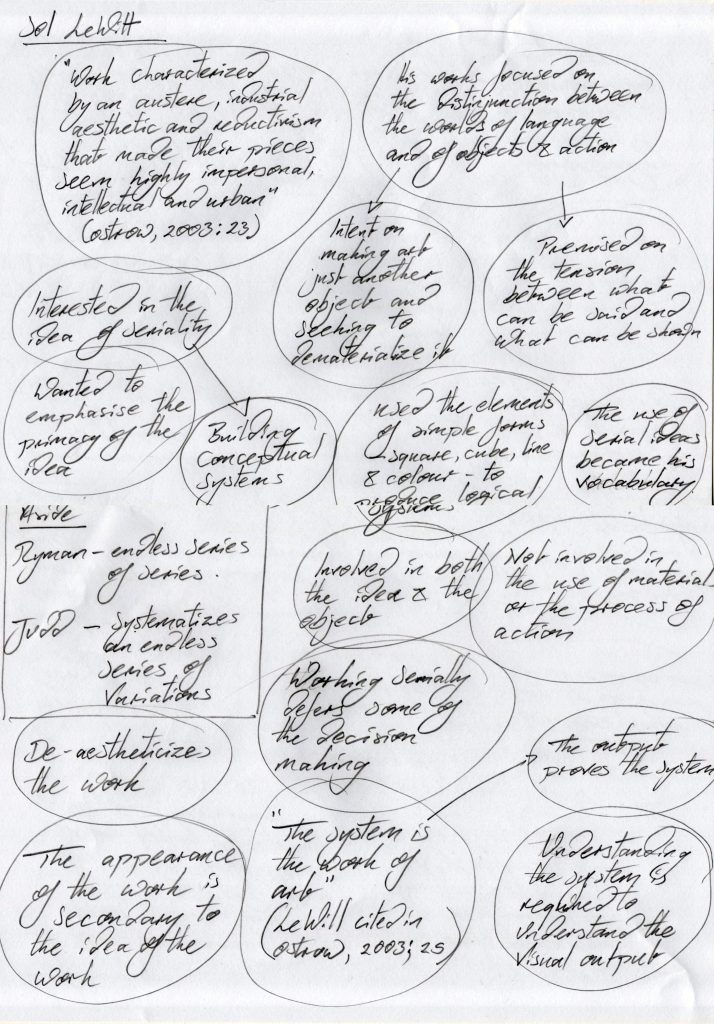
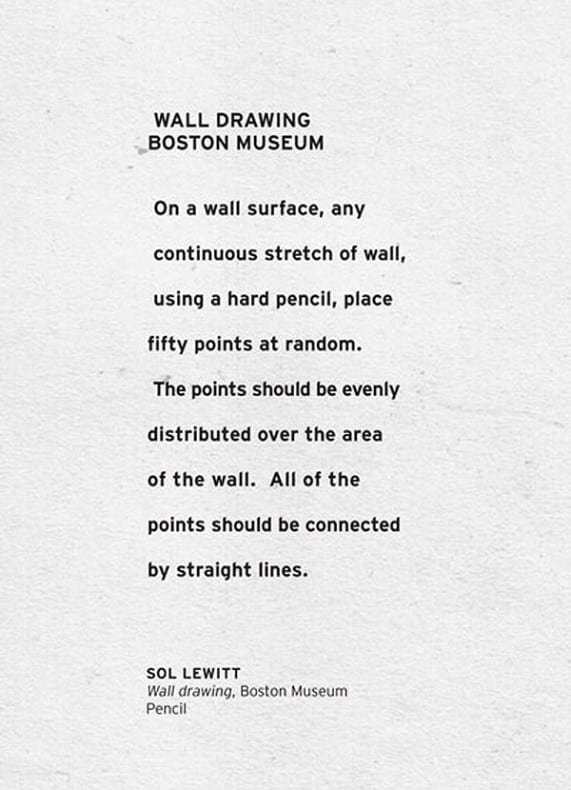
Fig.2. Wall Drawing 118 (1971)
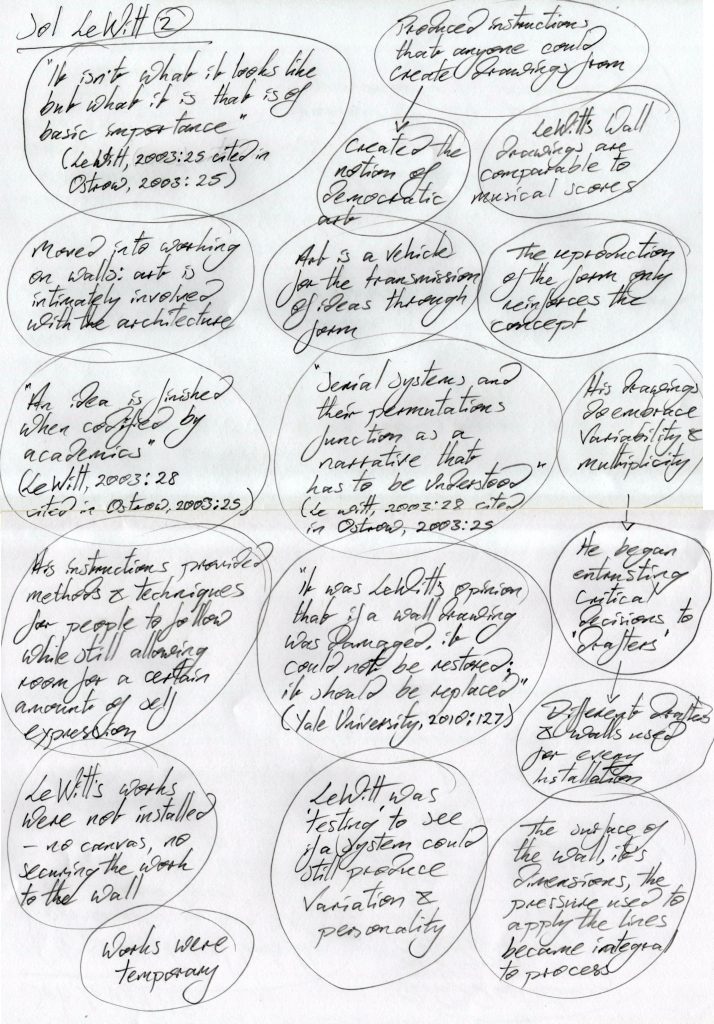
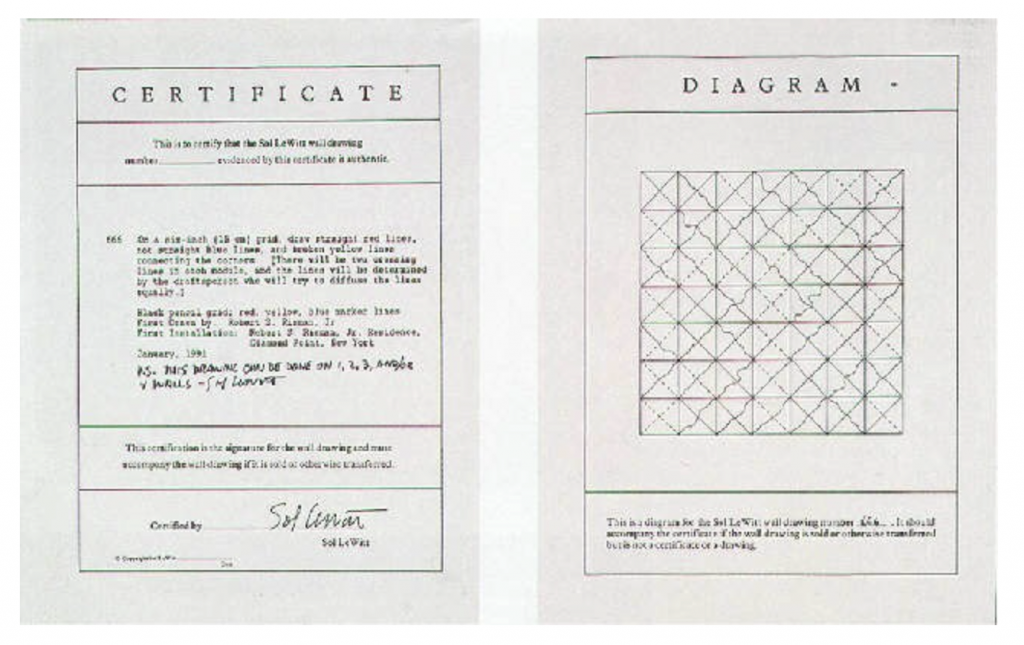
Fig.3. Wall drawing no.666 (1991)
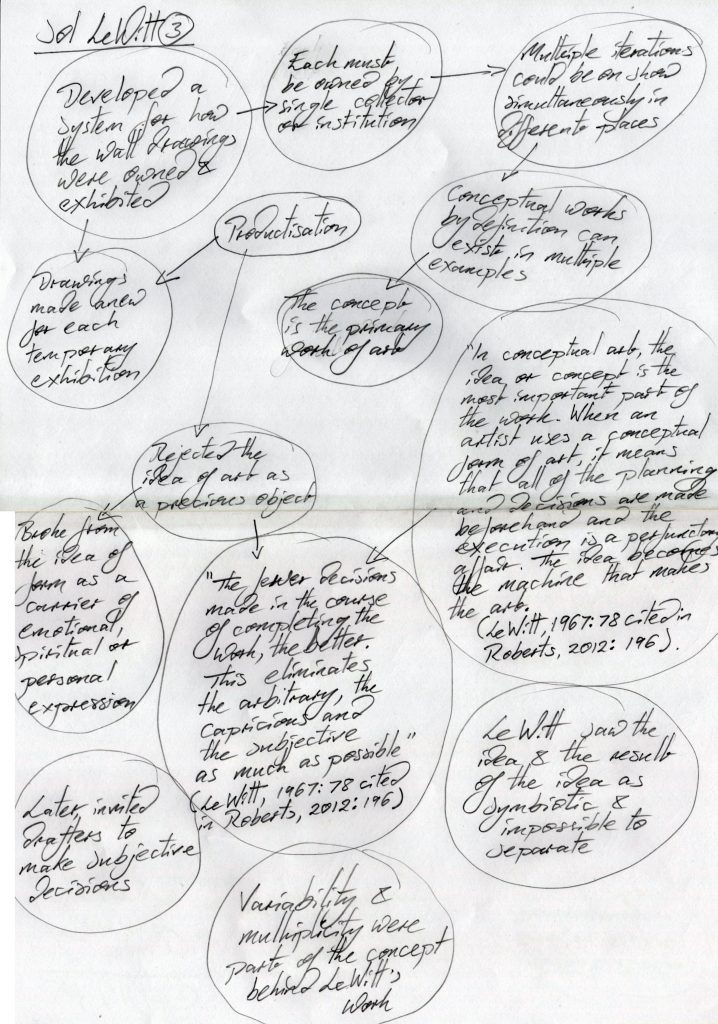
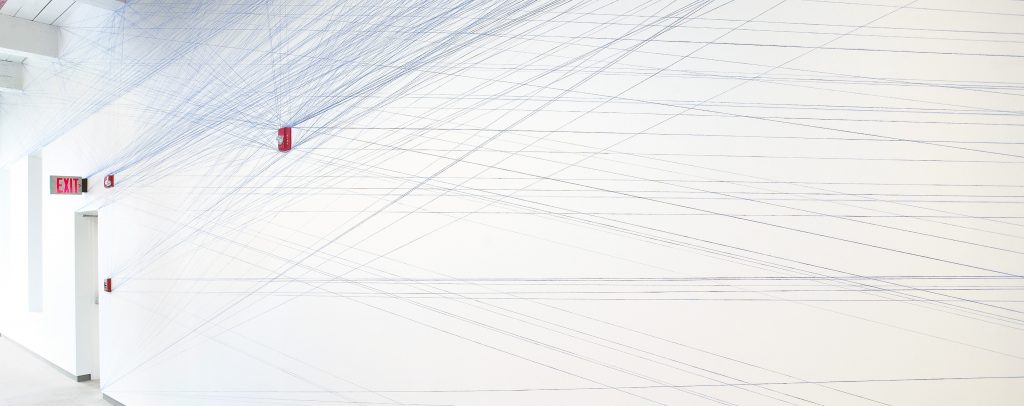
Fig.4. Wall Drawing 51 (1970)
All architectural points connected by straight lines.
(LeWitt, 1970 cited at https://massmoca.org/)
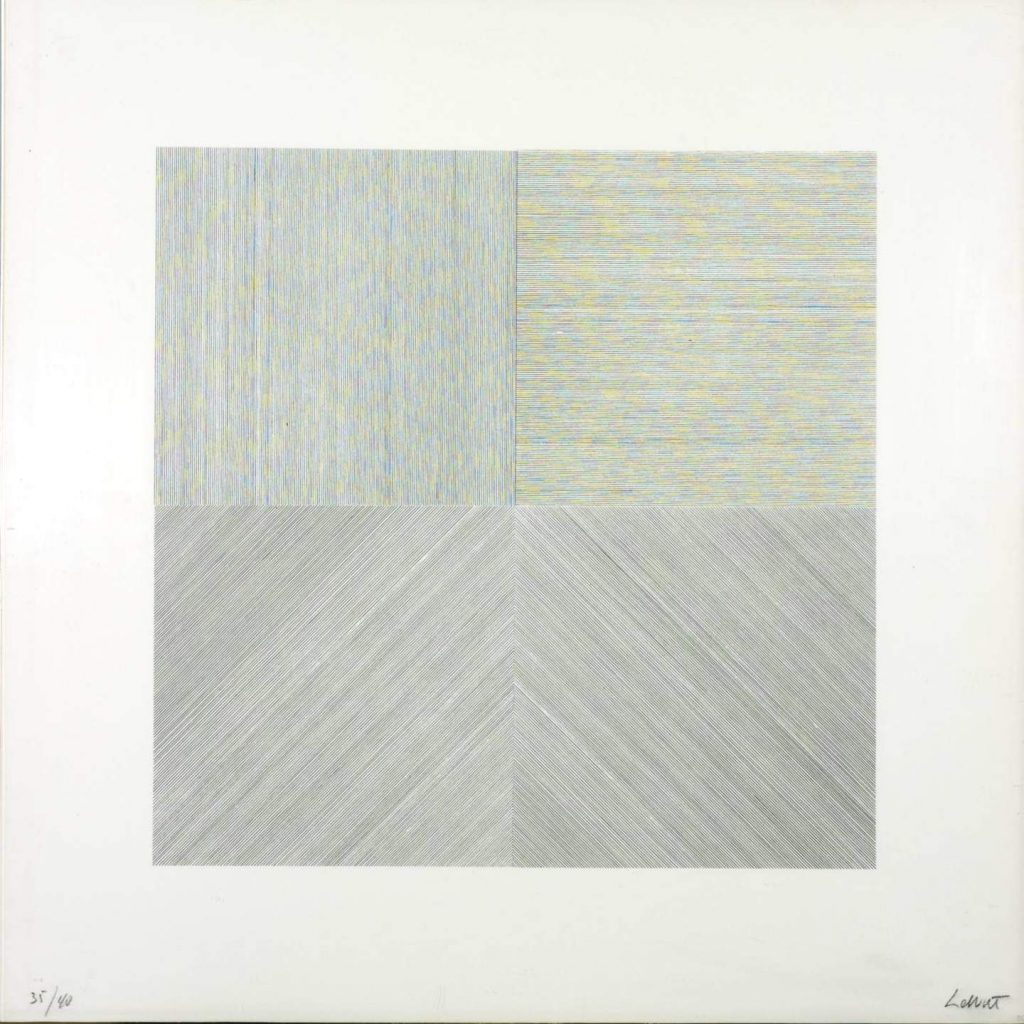
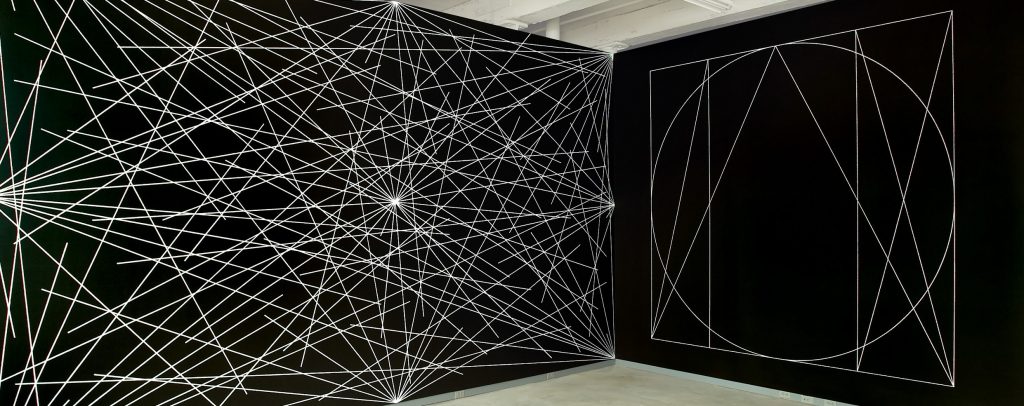
Fig.6. Wall Drawing 289 (1976)
A 6-inch (15 cm) grid covering each of the four black walls. White lines to points on the grids. Fourth wall: twenty-four lines from the center, twelve lines from the midpoint of each of the sides, twelve lines from each corner. (The length of the lines and their placement are determined by the drafter.)
(LeWitt, 1976 cited at https://massmoca.org/)
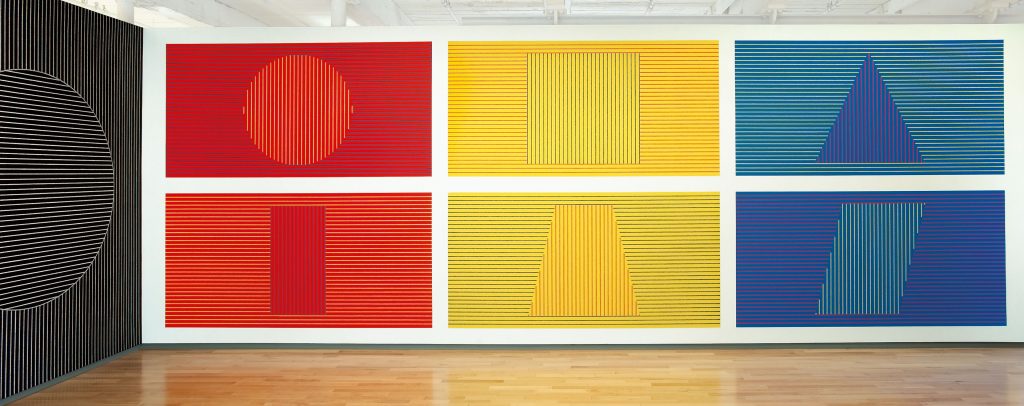
Fig.7. Wall Drawing 340 (1980)
Six-part drawing. The wall is divided horizontally and vertically into six equal parts. 1st part: On red, blue horizontal parallel lines, and in the center, a circle within which are yellow vertical parallel lines; 2nd part: On yellow, red horizontal parallel lines, and in the center, a square within which are blue vertical parallel lines; 3rd part: On blue, yellow horizontal parallel lines, and in the center, a triangle within which are red vertical parallel lines; 4th part: On red, yellow horizontal parallel lines, and in the center, a rectangle within which are blue vertical parallel lines; 5th part: On yellow, blue horizontal parallel lines, and in the center, a trapezoid within which are red vertical parallel lines; 6th part: On blue, red horizontal parallel lines, and in the center, a parallelogram within which are yellow vertical parallel lines. The horizontal lines do not enter the figures.
(LeWitt, 1980 cited at https://massmoca.org/)
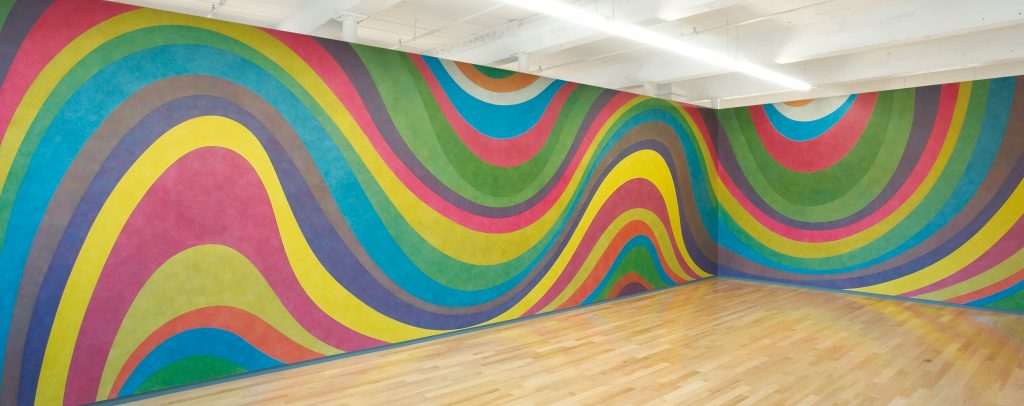
Fig.8. Wall Drawing 793A (1996)
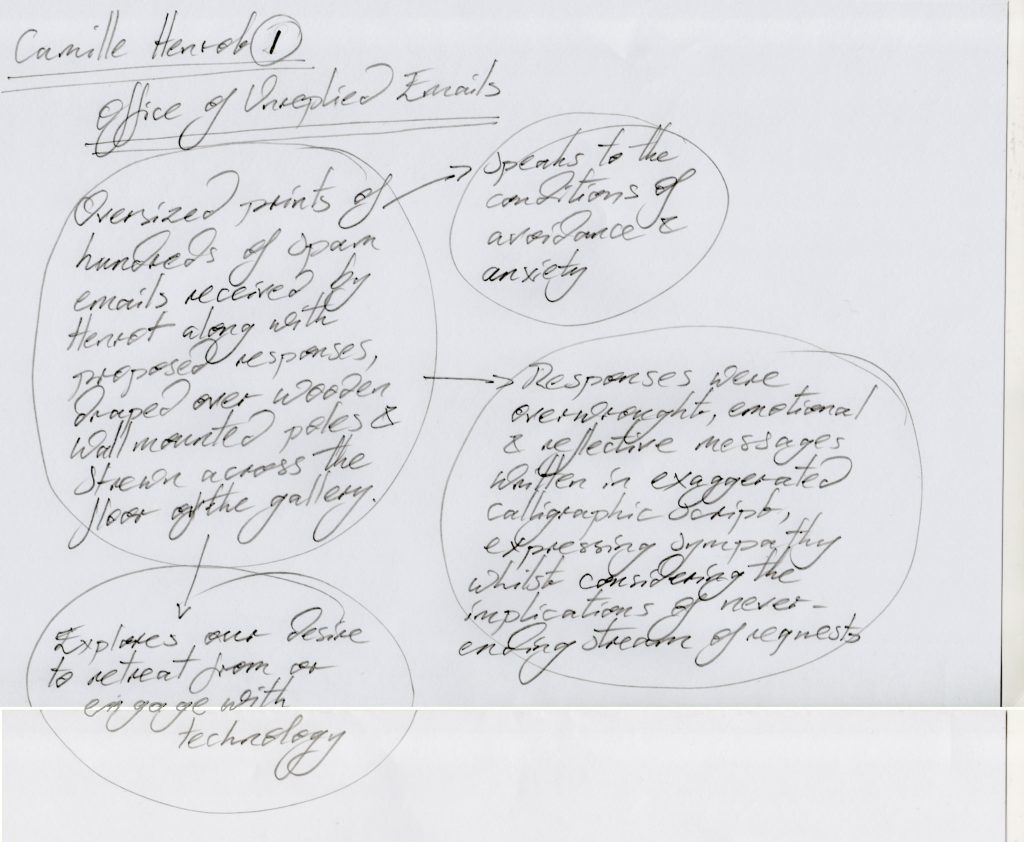
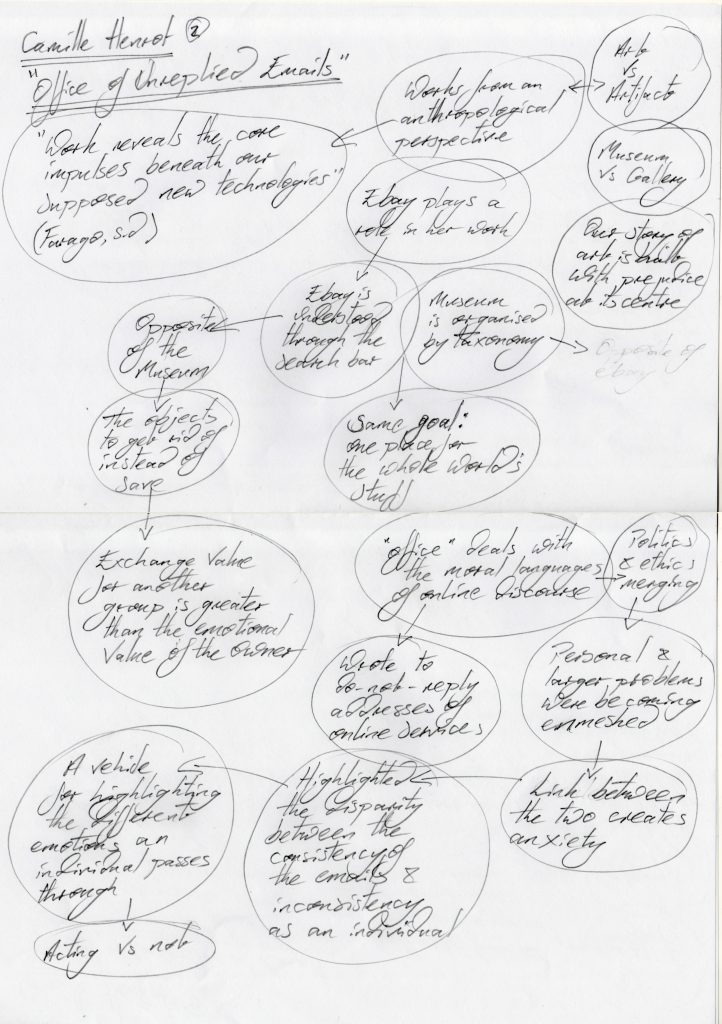
Camille Henrot
Key Observations
- Anthropological observation of how technology is manifesting avoidance and anxiety
- Explores our desire to retreat from or engage with technology
- explores how digital technology has changed the way and manner in which we communicate
- Asks questions about what constitutes art – and what constitutes artefact
- Positions artistic process and its resultant output as a form of cultural analysis
- Examines the taxonomies we use to organise societal systems
- Positions exchange value against emotional value and asks us which is important and to who
- Highlights how the story of art typically presented has prejudice at its centre – white, middle class, heteronormative – patriarchal
- Explores the moral languages of online discourse, how different layers of society (e.g. personal and the professional) are becoming enmeshed by technology
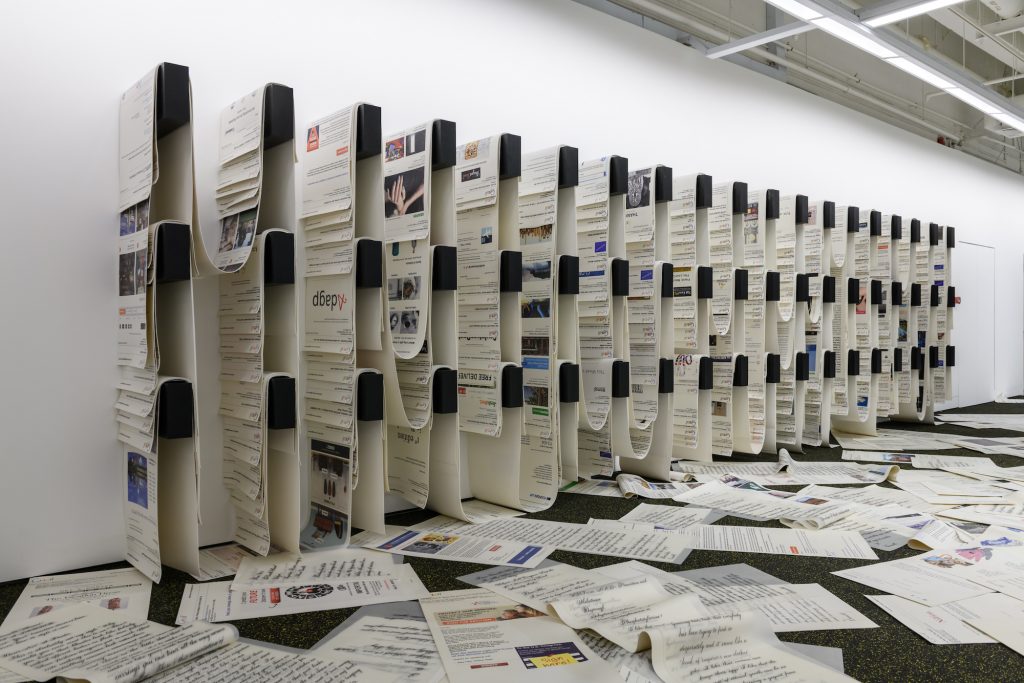
Fig.9. Office of Unreplied Emails (2016)
Hans Haacke
Key Observations
- Art as an interogation of an existing societal system
- Employs existing data and artefacts, found material, to critique the fraudulent activities of NYC slum lord
- Assembling and presenting the material, identifying the patterns and relationships, the systems in play, then narratively assembling it for display is the artistic process
- ‘Artistic journalism’ – where the evidence is the both report and the creative output
- This is a form of institutional critique – the property system, the governing systems are being critiqued
- When does documentation become art?
- This is a form of bricolage. Different objects are juxtaposed to reveal a third meaning
- Haacke’s work reflects on the permanently incomplete meaning of art works: the historical, social (et al) context of a work’s viewing will always shape critical perceptions
- Reflects on how art is shaped by commercial considerations, influences, how museums determine and limit the reading of art: the museum as a societal control mechanism
- Questions how owner interests affect cultural space
- The museum as a place of sanctuary for political and social commentators. Or the museum as a pl
- Value and perceptions of art changes with how its used and where its placed
- Museums occupy a position of material privilege in relation to other terrains
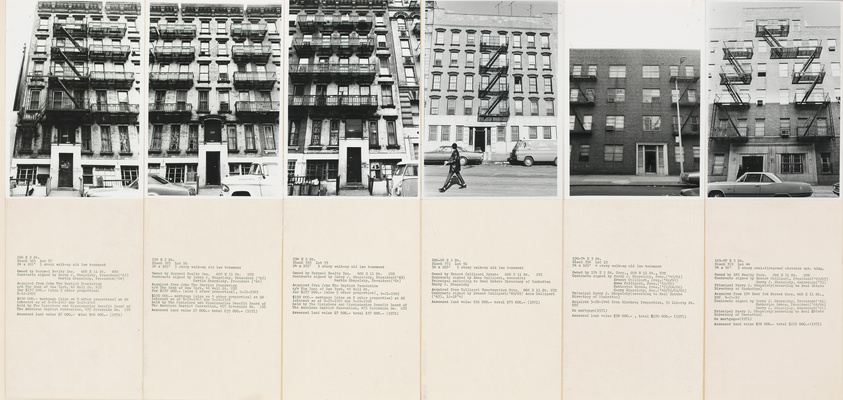
Fig.10 Shapolsky et al. Manhattan Real Estate Holdings, a Real-Time Social System, as of May 1, 1971 (1971)
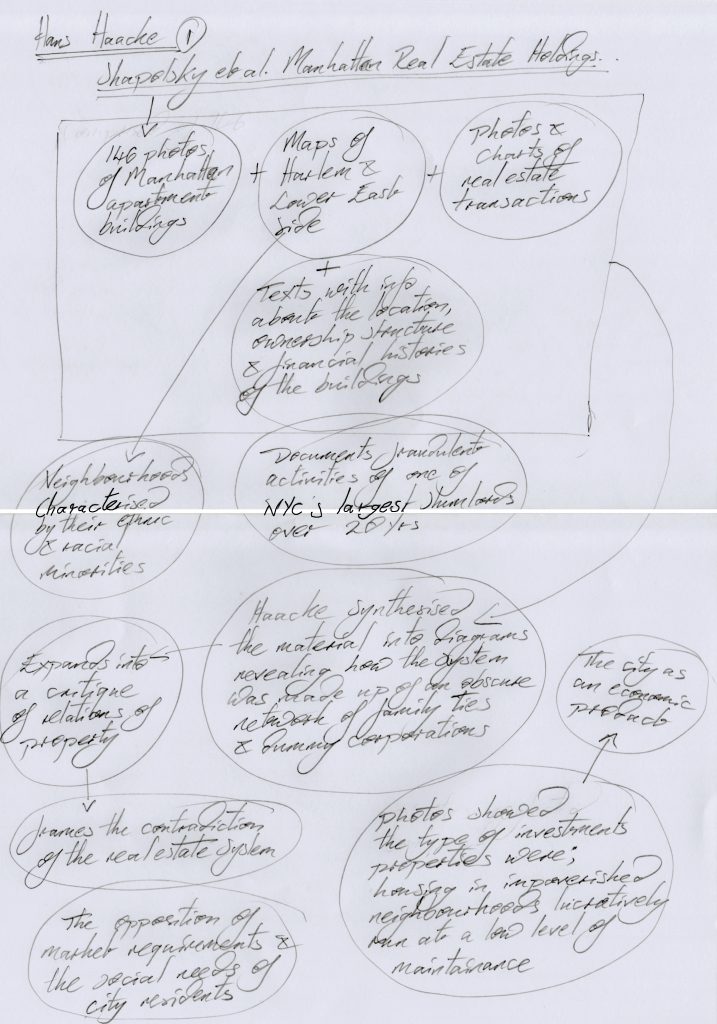
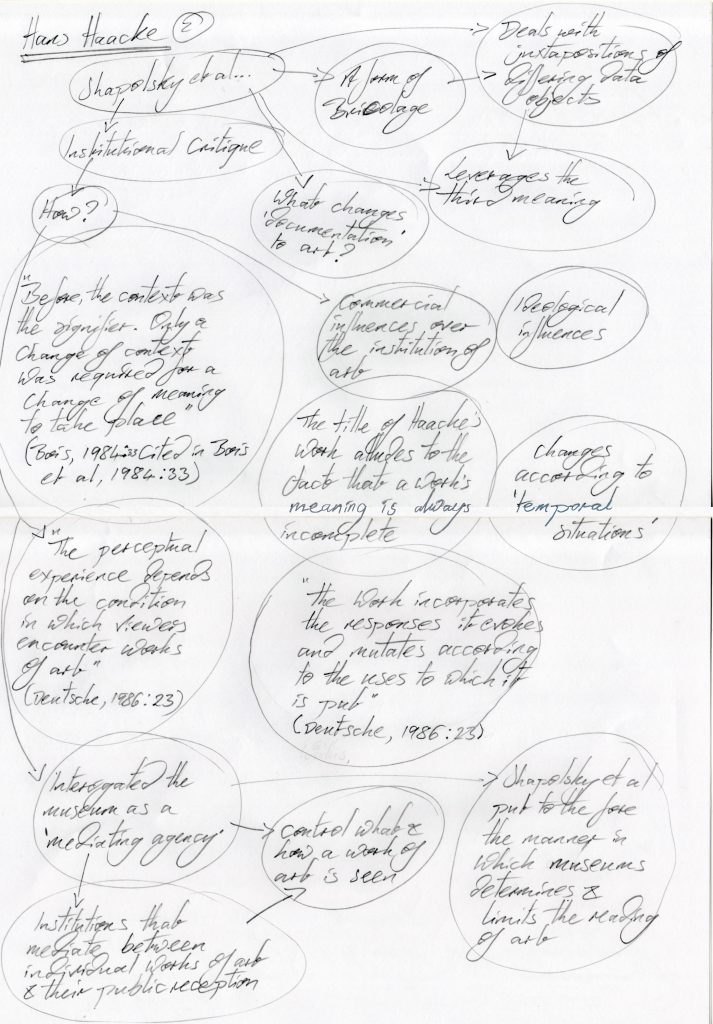

Fig.11. Shapolsky et al. Manhattan Real Estate Holdings, a Real-Time Social System, as of May 1, 1971 (1971)
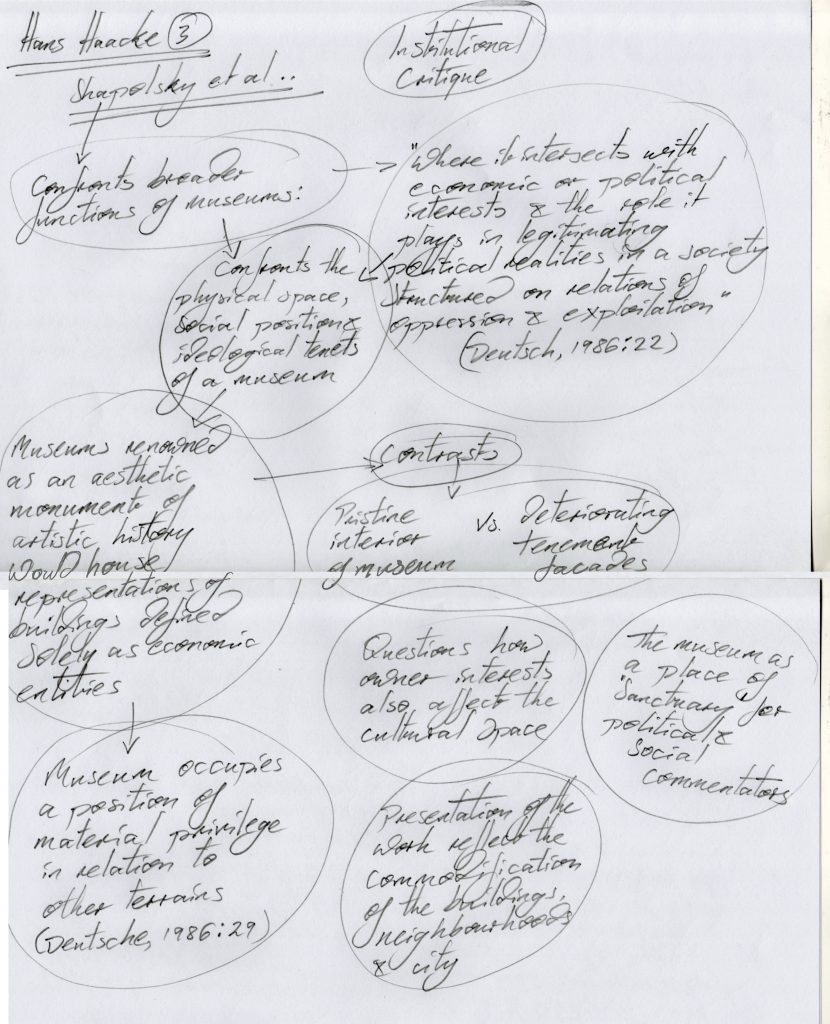

Fig.12. Shapolsky et al. Manhattan Real Estate Holdings, a Real-Time Social System, as of May 1, 1971 (1971)
Bibliography
Farago, J (2017) ‘An Interview with Camille Henrot” in Even Magazine At: http://evenmagazine.com/camille-henrot/ (Accessed 06/10/24)
Elephant (2019) ‘Out of Office: The Artists Interrogating the Workplace’ in Elephant At: https://elephant.art/out-of-office-the-artists-interrogating-the-workplace/ (Accessed 06/10/24)
Hauser and Wirth (2021) Camille Henrot joins Hauser & Wirth At: https://www.hauserwirth.com/news/35488-camille-henrot-joins-hauser-wirth/ (Accessed 06/10/24)
Whitney Museum (2024) Hans Haacke: Shapolsky et al. Manhattan Real Estate Holdings, a Real-Time Social System, as of May 1, 1971 At: https://whitney.org/collection/works/29487 (Accessed 06/10/24)
Hileman, K (2010) ‘Romantic Realist: A Conversation with Hans Haacke’ In: American Art 24 (2) pp. 74-93
Bois, Y-A. Crimp, D. Krauss, R. Haacke, H (1984) ‘A Conversation with Hans Haacke’ I In: October 30 pp. 23-48
List of References
Ostrow, S (2003) ‘Sol LeWitt’ in BOMB 85 pp. 22 – 29
Roberts, V (2012) ‘”Like a musical score”: Variability and Multiplicity in Sol LeWitt’s 1970s Wall Drawings’ In: Master Drawings 50 (2) pp: 193 – 210
Yale University (2010) ‘Time Will Tell: Ethics and Choices in Conservation’ In: Yale University Art Gallery Bulletin (2010) pp: 126-129
Zdebik, J (s.d.) ‘Diagrams: Art as Information’ in Drain Magazine At: https://drainmag.com/diagrams-art-as-information/ (Accessed: 05/10/24)
Deutsche, R (1986) ‘Property Values: Hans Haacke, Real Estate and the Museum’ In: Wallis, B (ed) Hans Haacke: Unfinished Business. London: MIT Press. pp. 20-39
List of Illustrations
Fig.2. LeWitt, S (1971) Wall Drawing 118 [Typed instructions for wall drawing] At: https://www.amygoodchild.com/blog/chatgpt-sol-lewitt-wall-drawings (Accessed 05/10/24)
Fig.3. LeWitt, S (1971) Wall Drawing no.666 [Drawing] At: https://www.artnet.com/artists/sol-lewitt/wall-drawing-no666-qokfZ6MXzPmFkrMHebTWag2 (Accessed 05/10/24)
Fig.4. LeWitt, S (1970) WallDrawing 51 [Drawing] At: https://massmoca.org/event/walldrawing51/ (Accessed 05/10/24)
Fig.5. LeWitt, S (1971) Untitled [Drawing] At: https://www.tate.org.uk/research/tate-papers/14/ideas-in-transmission-lewitt-wall-drawings-and-the-question-of-medium (Accessed 05/10/24)
Fig.6. LeWitt, S (1976) Wall Drawing 289 [Drawing] At: https://massmoca.org/event/walldrawing289/ (Accessed 05/10/24)
Fig.7. LeWitt, S (1980) Wall Drawing 340 (1980) [Drawing] At: https://massmoca.org/event/walldrawing340/ (Accessed 05/10/24)
Fig.8. LeWitt, S (1996) Wall Drawing 793A (1996) [Drawing] At: https://massmoca.org/event/walldrawing793b/ (Accessed 05/10/24)
Fig.9. Henrot, C (2016) Office of Unreplied Emails [Printouts, wooden poles] At: https://elephant.art/out-of-office-the-artists-interrogating-the-workplace/ (Accessed 06/10/24)
Fig.10. Haacke, H (1971) Shapolsky et al. Manhattan Real Estate Holdings, a Real-Time Social System, as of May 1, 1971 [9 photostats, 142 gelatin silver prints, and 142 photocopies] At: https://whitney.org/collection/works/29487 (Accessed 06/10/24)
Fig.11. Haacke, H (1971) Shapolsky et al. Manhattan Real Estate Holdings, a Real-Time Social System, as of May 1, 1971 [9 photostats, 142 gelatin silver prints, and 142 photocopies] At: https://garadinervi-repertori.blog/post/675746654984519680/hans-haacke-shapolsky-et-al-manhattan-real (Accessed 06/10/24)
Fig.12. Haacke, H (1971) Hans Haacke: Shapolsky et al. Manhattan Real Estate Holdings, a Real-Time Social System, as of May 1, 1971 [9 photostats, 142 gelatin silver prints, and 142 photocopies] At:https://datasmart.hks.harvard.edu/news/article/from-prosaic-to-personal-transforming-city-data-through-art-1085 (Accessed 06/10/24)