

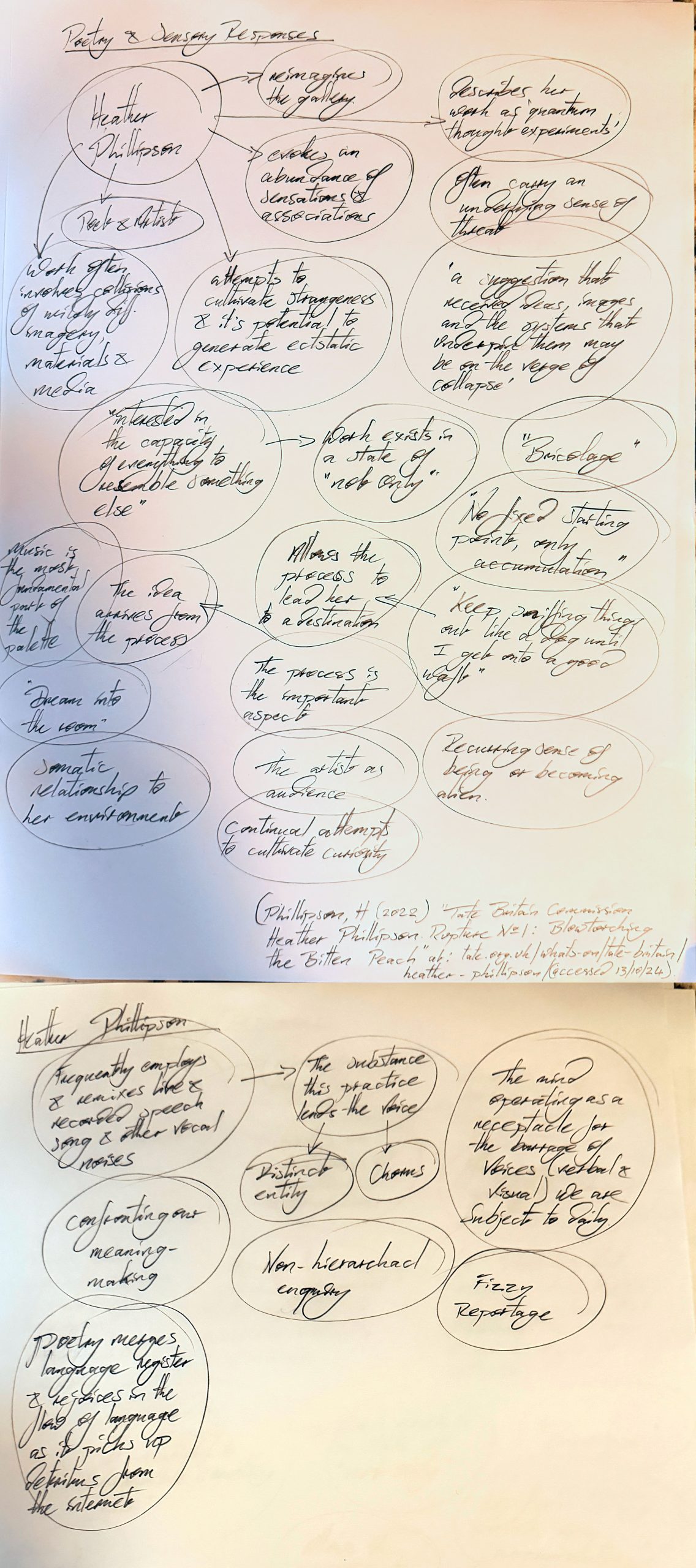
Heather Phillipson
‘Of the Sub-Contract: An Interview with Nick Thurston’, Stephen Voyce
Nick Thurston’s interview with Stephen Voyce discusses the themes of his book “Of the Subcontract,” which explores the precarious labor dynamics on Amazon Mechanical Turk. The conversation delves into the concepts of appropriation, authorship, and the role of digital platforms in shaping contemporary poetry and labor. Thurston critiques the illusion of self-determination in gig work, emphasising the commodification of creative expression and the paradoxes inherent in subcontracting poetic labor.
Highlights -📚
- Conceptual Writing: Thurston discusses his alignment with conceptualist writing and its community. ✍️
- Amazon Mechanical Turk: The platform is critiqued for its exploitative labor practices hidden behind the guise of efficiency. 💻
- Subcontracting Poetry: “Of the Subcontract” features poems commissioned from workers on AMT, exposing the commodification of creative labor. 📝
- Cultural Commentary: The book serves as a commentary on the precarity of modern work and the blurred identities of gig workers. 🔍
- Visual Elements: The cover art and illustrations relate to Amazon’s branding, reflecting the digital economy’s aesthetics. 🎨
- Paradox of Authorship: Thurston interrogates the authenticity and authority of poetry created through subcontracted labor. 🤔
- Political Implications: The text highlights the socio-economic realities of the precariat class in a digital labor landscape. ⚖️
Key Insights -💡
- Appropriation vs. Depropriation: Thurston emphasizes the importance of depropriation in contemporary art, where work is reinterpreted rather than simply copied. This challenges the notion of originality in an age dominated by digital reproduction. 🔄
- Labor as Commodity: The interview reveals how Amazon’s Mechanical Turk reduces labor to a transactional commodity, stripping workers of their identities and reducing creative expression to mere tasks. This commodification raises ethical questions about digital labor. 💰
- Community of Practice: Thurston’s collaborative work with other conceptual writers underscores the significance of community in challenging traditional literary forms. This collective approach enriches the discourse around what constitutes literature today. 🤝
- Poetic Experimentation: By commissioning poems from workers, Thurston experiments with the boundaries of authorship and creativity, questioning what it means to be a poet in the gig economy. This raises critical reflections on the nature of artistic expression. 🎭
- Cultural Critique: The book acts as a critique of modern capitalism, revealing how digital platforms perpetuate inequalities while masquerading as innovative solutions. This critique is essential for understanding the socio-political landscape of contemporary labor. 🌍
- Identity in the Cloud: The discussion highlights how digital labor platforms erase individual identities, presenting workers as mere data points within a larger system. This phenomenon reflects broader trends in how we view work and identity in the digital age. ☁️
- Future of Literature: As Thurston explores the implications of subcontracted creativity, he raises questions about the future of literature and artistic integrity in a world increasingly dominated by digital economies and gig work. This prompts a reevaluation of literary values in contemporary society. 📖
‘Poetry as Material Intervention in Contemporary Art’, Ilse van Rijn
Ilse van Rijn explores the role of poetry in contemporary visual art, arguing that it has the potential to restructure institutional thought. Drawing from her PhD research, she discusses how poetry serves as a material intervention, challenging traditional meanings and interpretations of language, and advocating for justice and recognition of marginalized communities.
Highlights -📄
- Poetry’s Presence: Poetry is increasingly integrated into contemporary art, with events and exhibitions highlighting its relevance.
- Complexity of Language: Poetry unsettles our understanding of language, often obscuring clear meaning and resisting traditional interpretations.
- Diverse Forms: Different artists use poetry in varied ways, emphasizing its materiality—from sound to text—demonstrating its multifaceted nature.
- Cultural Critique: Works like Alice Creischer’s His Master’s Voice challenge institutional language and power structures through poetic recontextualization.
- Embodied Language: The performance aspect of poetry, such as in Karl Holmqvist’s works, reveals the physicality of language as a material form of expression.
- Knowledge Generation: Poetry generates knowledge through its unique engagement with language, acting as a means to voice what cannot be articulated in conventional terms.
- Advocacy for Justice: Poetry in visual art is positioned as a vehicle for advancing social justice and addressing historical marginalization.
Key Insights -💡
- Restructuring Thought: Poetry’s ability to disrupt conventional thought patterns allows it to challenge and potentially reshape institutional frameworks in art and society. This suggests that poetry is not just a form of expression but a tool for critical engagement.
- Transcending Language Barriers: The complex interplay between language and meaning in poetry invites deeper exploration and interpretation, revealing the limitations of traditional linguistic frameworks. This indicates that poetry can bridge gaps between subjective experiences and broader social discourses.
- Materiality of Poetry: The diverse material forms of poetry—from written text to performance—highlight the importance of context in understanding its impact. This emphasizes that poetry’s significance lies not only in its content but also in how it is presented and experienced.
- Political Engagement: Works that appropriate institutional language, like those by Creischer, expose the political and corporate underpinnings of art institutions, showcasing poetry’s potential to critique and reflect on societal structures.
- Intimacy in Art: Poetry can create intimate connections within art installations, inviting viewers to engage with complex emotions and ideas. This intimacy challenges the often detached nature of contemporary art practice.
- Embodiment and Expression: The physical act of performing poetry transforms it into an embodied experience, suggesting that the performative aspect is crucial in conveying its meaning and emotional weight.
- Justice and Advocacy: Poetry serves as a powerful means of advocating for social justice, particularly for marginalized communities, reinforcing its role as a vital component of contemporary art that seeks to address inequities and promote inclusivity.
Bibliography
Tate (2022) Tate Britain CommissionHeather Phillipson RUPTURE NO 1: blowtorching the bitten peach At: https://www.tate.org.uk/whats-on/tate-britain/heather-phillipson (Accessed 13/10/24)
van Rijn, I (2019) Poetry as Material Intervention in Contemporary Art At: https://sandbergseries.nl/journal/language/poetry-as-material-intervention-in-contemporary-art (Accessed 13/10/24)
Voyce, S. Thurston, N (2014) Of the Subcontract: An Interview with Nick Thurston In: The Iowa Review 44(1) pp.94-108 (Accessed 13/10/24)