
Exhibition of Body of Work
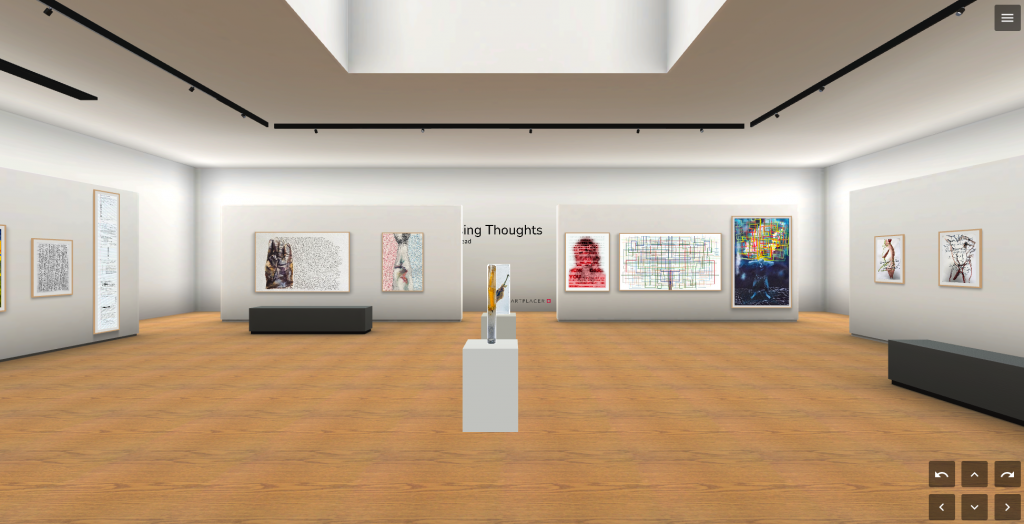
https://assets.artplacer.com/virtual-exhibitions/?i=20633#
Catalogue
Note
There is discontinuity between Project 7, Exercise 3 and the whole of Project 8 which has proved confusing. P7, Ex 3 says:
In project 8, you will be asked to work towards an ambitious body of work, culminating in an exhibition, intervention, curation, or outward-facing dissemination of work.
However Project 8, Exercise 2, where I think the requirement to deliver that requirement for an “exhibition, intervention, curation, or outward dissemination of work” exists, the wording is relatively vague, focusing on considering and exploring a range of formats of documentation and documenting tests and trials and not on delivering a summative external dissemination. I would suggest that the wording across the exercises in P7 and P8 needs tightening up to establish a clearer connection between them.
Reflection
Positioning this project towards the end of the unit, after so many in-depth research/writing-based exercises have dominated time and attention, has somewhat hamstrung my potential output. Wouldn’t it be better to lead students through developing a body of work across the entire unit, rather than cram the curation and making in towards the end, when time is tight and the unit end date is looming? Or reduce the scale and scope of the previous projects to allow greater space for a more fertile period of making towards the end? And how is an ‘ambitious body of work’ quantified against the unit requirements – creating five new pieces was ambitious for me bearing in mind my ambitions, my comments above and my professional responsibilities.
I say all of that with the perspective that this project has been both the most enjoyable and significant for me, because of the way that the learning strands have coalesced to enable me to think about then deliver a defined creative output, albeit one that has strayed from the requests in the exercises. By actually focusing on delivering a form of summative exhibition beyond just a ‘range of formats of documentation of the process’ etc (as Ex 2 requested), I was enabled to refine my curation proposal with a deeper identification of the themes of my work, how the seemingly disparate materiality does connect, and how to add layer of professionalisation to it e.g. in terms of costing etc. Because of the fragmentary approach to ‘making’ exercises through the unit I was seeing the work as individual pieces, and not as a body, which in turn prevented me from constructing a cohesive curation proposal in the first instance. I had a ‘wide’ sense of what I was trying to do and say, but it wasn’t until I had a space to hang in and began thinking about all of the work I had produced (and was continuing to produce), how the pieces existed alone and together in that space, that the thematic components matured.
I feel it’s important to mention here that in P7, there is no guidance around how to structure a curation proposal, the details that are required are not explained anywhere and the requirements are somewhat ‘woolly’. Curation as a process and a foundation for creation/ organisation of a body of work is not explained within the project. That I suggest is contributing to the lack of consistency between P7 and P8, as well as uncertainty amongst students about what a curation proposal is.
I see my ‘body of work’ as having developed over the entire unit and not something I am developing purely for P8. Over the course of IRW the thematic strands that resonate with my personal values have become increasingly more pronounced – patriarchy, oppression, othering, privilege etc – and I am more conscious in the decisions I am making about my creative realisations. The mapping exercises of the earlier projects have served an establishing purpose, but I haven’t really referred to them since, as the themes are secure in my mind. The process to making a piece of work acts to further cement and then extend those themes in my mind: it’s like note-taking during a meeting to secure thoughts and ideas in my mind. Each time I make a piece it reinforces my personal connection to the themes, and it also begins identifying new germinations that can be used to create new works – as with the resin pieces then forming ‘Adam’.
My process behind the making has developed because of the research processes we have undertaken. I have begun carrying a rudimentary (but effective) bullet journal with me in which I capture thoughts and ideas as they arise. This gives me a catalogue – an archive – of germinations to pull from. I have transposed and iterated my mind-mapping technique into the underpinning creative research, using it to develop those initial ideas, map my thinking and follow pathways to basic visualisations that extend ideas into the realm of sketches and work. This is becoming part of the archive – I just need a better organisation system for it, one that exists outside of the academic learning log. Another observation: a lot of the practices we are being challenged to develop are profoundly valuable, yet have to exist within the boundaries of academic requirements. This is tempering their effectiveness for use beyond academia: for instance, when we creating a body of work, the different components of that are distributed across multiple, disconnected learning log posts, whereas beyond OCA, they would be organised in relation to that body of work.
Other research subjects from the unit have surreptitiously influenced my making. The concept of a narrative both in a single piece and across a collection, using speculative narrative, exploring alternate materials, moving beyond considering myself only as painter, the form as well as the function of text, the idea of the idea leading the choice of material. I am exploring deeper themes, initiated by Barthes work on semiotics, and feminist thinkers including bell hooks and Audre Lorde. Importantly, for me, I am looking at the work of minority artists and artists of colour. The work they are producing is profoundly rich in narrative, aesthetics, and discourse, and is challenging me to become aware of the privileges and power that exist in an overtly privileged, white, male, heterosexual world, of which I am an example.
How well did I manage the curation aspects of the project…? I find that a difficult question to answer as I feel that P7 doesn’t really introduce us to the ‘practice of curation’. It provides examples of how bodies of work have been curated, asks us to reflect on ideas, then write a curation proposal. But a more defined curatorial process in relation to developing and organising our own ideas – I don’t feel that’s present across P7’s exercises. My sense of what is meant by ‘curatorial aspects’ in summary is considering a) the connecting themes that shape the body of work and its exhibition, b) the space in which it is displayed, c) the scale of the work, d) the relationship of each piece of work to the others that make up the body, c) the narrative that is formed, d) how the body of work relates to the body of the viewer (these practical, theoretical and philosophical considerations need detailing in P7). Measured against those, I am satisfied to an extent with the ‘curation aspects’. Being able to consider the body of work as a whole within a clearly identified space helped me to refine the overarching theme and constituent subjects. Importantly, I was able to develop a curation idea that was unique, personal, intimate, not based on simply ordering by date or scale and with a potentiality for continuous development of work. In selecting the online space, with its lack of traditional boundaries (attendants, entry fee, opening/ closing times) my intent was (is) to broaden its reach beyond the usual art going audiences. It is also a ‘safe space’ for me to put work out there, a simulacrum that protects the vulnerability I feel with physically exhibiting work. I am not confident that my work is worthy of gallery space – this virtual space is allows me to ‘tip-toe towards plucking up courage’. And lastly, it has a purpose as part of the research and making process. The virtual gallery allows me to test arrangements to experiment with the relationship between works and between themes. It’s a sandbox for me to play with the scale of works, to understand how different sizes alter how the viewer can experience them and how the narrative of the works and the exhibition can be changed. It allows me to place frames around them, another device that affects the viewers relationship with the work.
The virtual space does raise issues though. I am limited by the cost I am willing to pay to a single gallery option, which is a white cube model. On the plus side, it has been suggested that this is a secularised space which allows modern artists to develop their autonomous ideas and show their artistic identity (Brüderlin, 2013). But on the negative side it does persist white patriarchal grand-institutional narratives, making the reading of art a problem (O’doherty, 1986). I am still cogitating on whether I am continuing or disrupting those narratives through displaying work with these themes in a space of this type.
List of References
Brüderlin, M. (2013) The aura of the White Cube. The sacred room and its traces in the modern exhibition room. Zeitschrift für Kunstgeschichte. 76 (1), 91–106.
O’doherty, B. (1986). Inside the White Cube: the Ideology of the Gallery Space. Berkeley: University of California Press.