
The Self as Subject and Method: Positioning My Artistic Practice as Autoethnography
This critical review will explore how artistic practice functions as autoethnography by fulfilling its primary methodological requirements: the systematic exploration of personal experience, the relationships between the individual and cultural contexts, and the use of reflexive investigation to generate knowledge. And by investigating the parallels between theoretical foundations, methodologies and practical realisations of wider contemporary art in relation, and through discussion of how the practices of artists such as Marina Abramović and Kara Walker qualify as autoethnography, I will syllogistically position how my merging of research and creative expression validates my practice as a form of autoethnographic research.
The Theoretical Foundations: Autoethnography and Artistic Enquiry
Autoethnography, as defined in Adams, Bochner and Ellis (2011, 273) is a qualitative “approach to research and writing that seeks to describe and systematically analyze personal experience in order to understand cultural experience”. It’s a definition originally written to characterise the actions and goals of anthropological researchers, but I would moot that it equally characterises the practice of many contemporary artists, including my own. Viewing artistic practice through the lens of this definition, highlights the methodological synchronicities, shifting it from mere creative output to a legitimate form of autoethnographic research that positions the artist as ‘researcher-as-instrument’, interrogating cultural phenomena through their personal narrative and aesthetic expression.
Traditional ethnography separates the objective researcher from their subjects of study. But in the 1960’s the ethno-psychiatrist, Georges Deveraux proposed “that observers in the social sciences had not yet learned how to make the most of their own emotional involvement with their material…the subjectivity of the observer…influences the course of the observed event” (Behar, 1996, 6). As Behar continues to rationalise throughout the “Vulnerable Observer” this false dichotomy between the objective researcher and subjective experience is effectively constraining valuable enquiry. Autoethnography dissolves this separation by positioning the researcher’s lived experience as both subject of exploration, and the vehicle through which cultural understanding is developed.
Historically, artistic practice has also functioned as a form of cultural enquiry, with artists acting as both subjects and interpreters of their social contexts. From the Romantics emphasis on freedom of expression, the Futurists’ rejoicing of the technological triumph of the early 20th Century, to Basquiat’s incisive critiquing of the persistence of colonial attitudes and Tracy Emin’s confessional vulnerability – all show how artistic practice is in natural alignment with autoethnographic principles. These – and many other contemporary practitioners – do not merely create aesthetic objects: they systematically explore their personal experience to reflect on broader cultural phenomena.
In his book “Art Practice as Research: Inquiry in Visual Arts”, Graeme Sullivan argues that “artistic inquiry involves a process of creating meaning that yields insights not accessible through other research processes.” (Sullivan, 2010, 41). This creation of meaning through artistic practice mirrors autoethnography in its emphasis on experiential knowledge production, where the reflexive examination of lived experience rather than objective observation leads to the creation of meaning.
Methodological Parallels: Process as Research
When examining the emphasis on process, reflexivity and narrative construction in both artistic practice and autoethnography, methodological parallels become apparent. In both, sequential, predefined, research paths are dismissed in favour of emergent, iterative processes through which meaning develops from practice and reflection.
Both artists and autoethnographers share reflexive stances. Leon Anderson emphasises the importance of “analytic reflexivity” in relation to autoethnography – “At a deeper level, reflexivity involves an awareness of reciprocal influence between ethnographers and their settings and informants. It entails self-conscious introspection guided by a desire to better understand both self and others through examining one’s actions and perceptions in reference to and dialogue with those of others.” (Anderson 2006, 382). Reflexivity is inherent in artistic practice, as artists continually negotiate between their internal experiences and external cultural contexts. The studio is the situation for reflexive enquiry, offering a space where materials, processes and personal narratives intersect, generating new understandings.
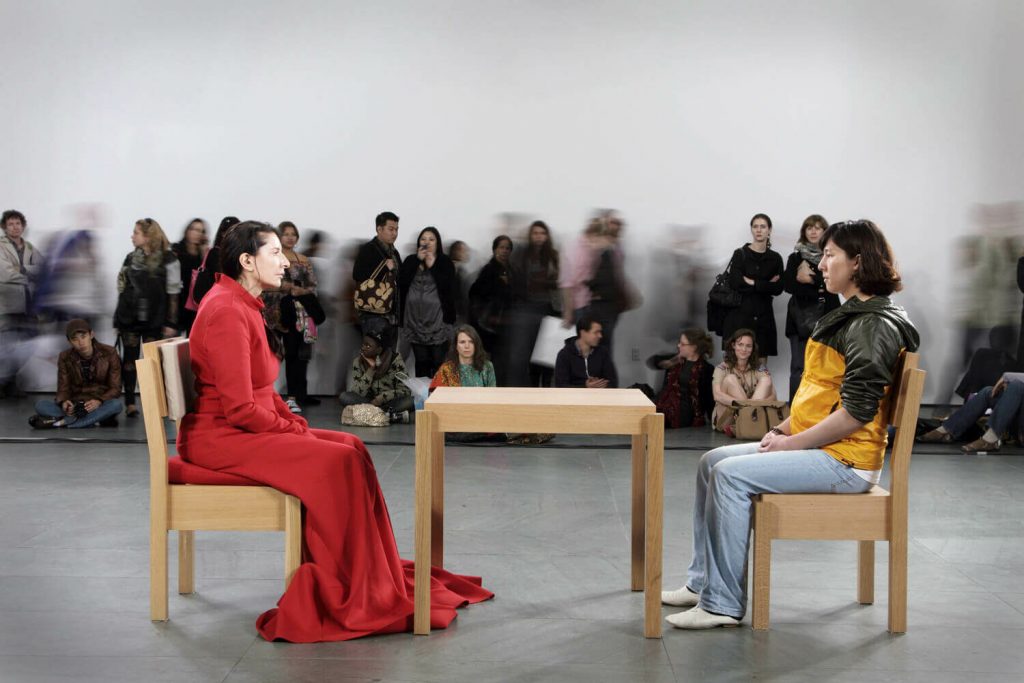
Fig.1. The Artist is Present (2010)
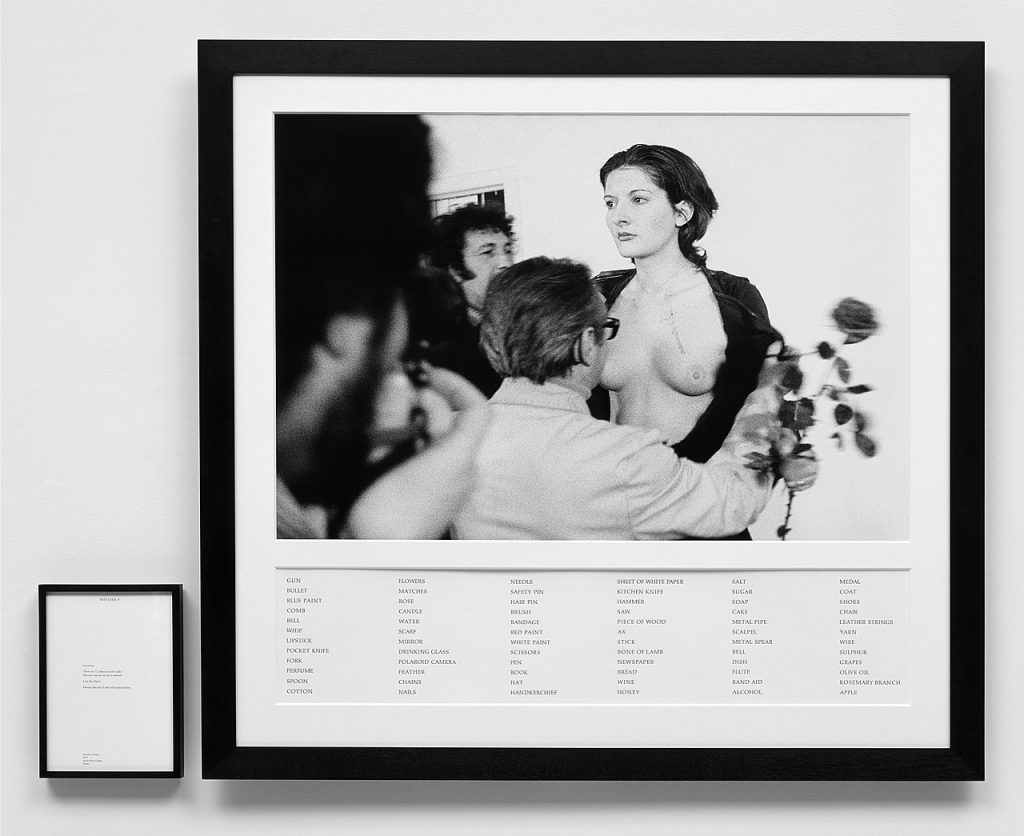
Fig.2. Rhythm O (1975: published 1994)
Consider how the interdisciplinary, research-based practice of Marina Abramović aligns with the definition of autoethnography. Abramović consistently positions her own physical and emotional experiences at the centre of her work to explore broader cultural phenomena, employing her body as both research instrument and subject. Intimate experiences of pain, vulnerability and endurance are transformed into shared cultural enquiry. Works such as “The Artist is Present” (2010) and “Rhythm O” (1974) surface knowledge about human connection, power dynamics and social boundaries through lived experience, rather than traditional analysis. Situating herself as an “ex-Yugoslav” adds reflexive depth to her work, whilst careful documentation creates narratives linking personal embodied knowledge to universal cultural understanding – the core methodology of autoethnography. Abramović’s practice “represents an effective and powerful example of the body-as-a-text in which subjectivity can be re-expressed and reinvented…that results in a redefinition of a subjective and, simultaneously, collective experience of identity”. (Demaria 2004, 295).
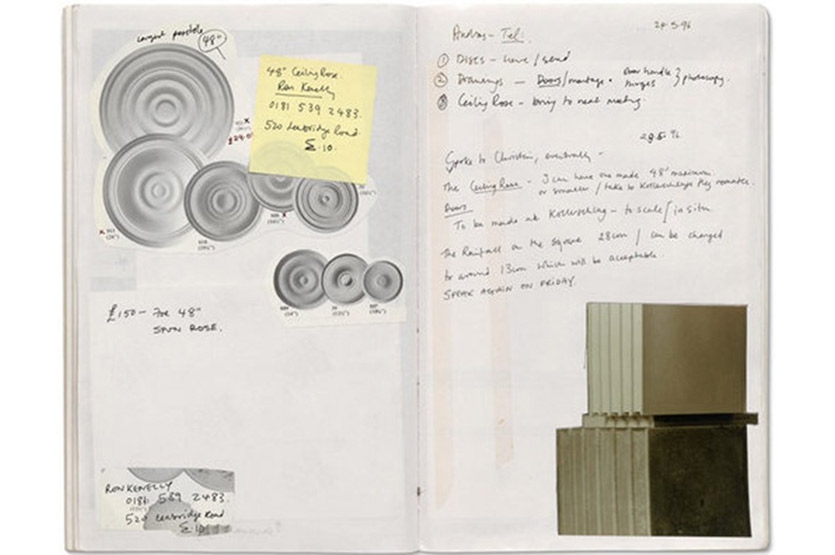
Fig.3. Detail from Rachel Whiteread Untitled (Vienna) 1996 Sketchbook (1996)
Artistic documentation and analysis further reflect autoethnographic methodologies. Sketchbooks, research journals, photographic records – all mirror the fieldnotes of traditional ethnography. These are documents that capture the evolution of aesthetic ideas, cultural contexts, personal reflections and analytical insights that inform the creation of work. And where artists such as Rachel Whiteread discuss their work in artist statements, interviews or catalogues, they are engaging in analytical reflection that characterises autoethnography.
Cultural Analysis through Personal Narrative
Autoethnography generates knowledge by connecting personal experience with cultural phenomena. As Chang explains, it is “autobiographies that self-consciously explore the interplay of the introspective, personally engaged self with cultural descriptions mediated through language, history and ethnographic explanation” (Ellis and Bochner, 2000:742 cited in Chang, 2008:46). Similarly, artistic practice grounds cultural analysis in personal narrative, whilst employing systematic creative methods to surface insights.
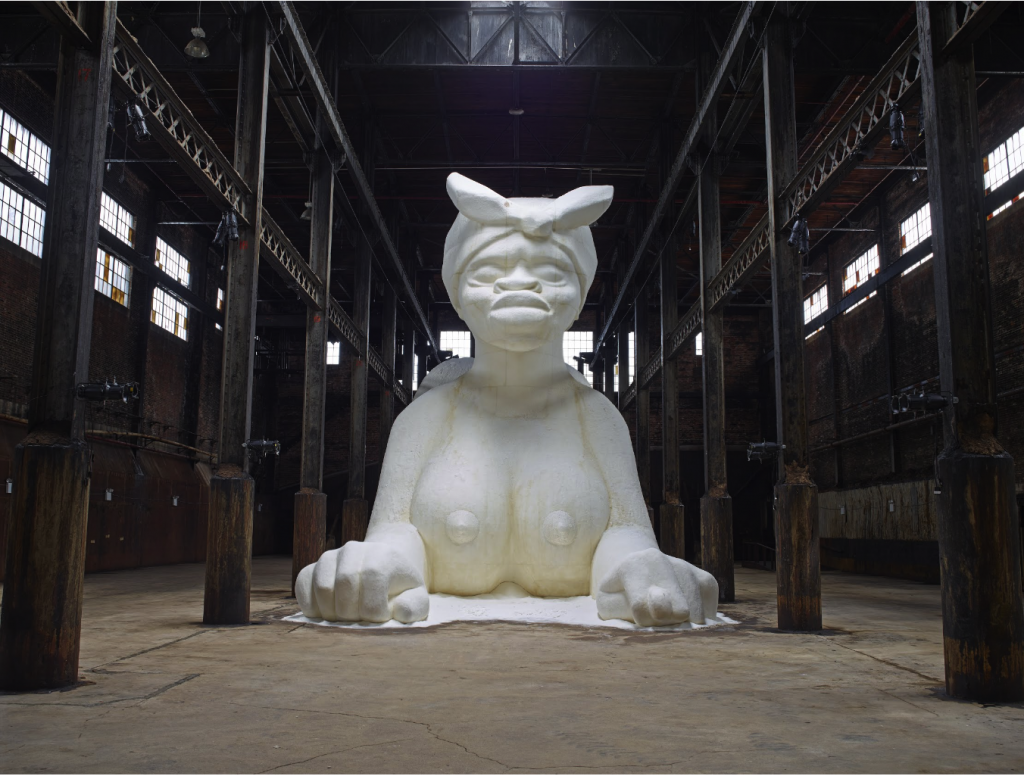
Fig.4. A Subtlety (2014)
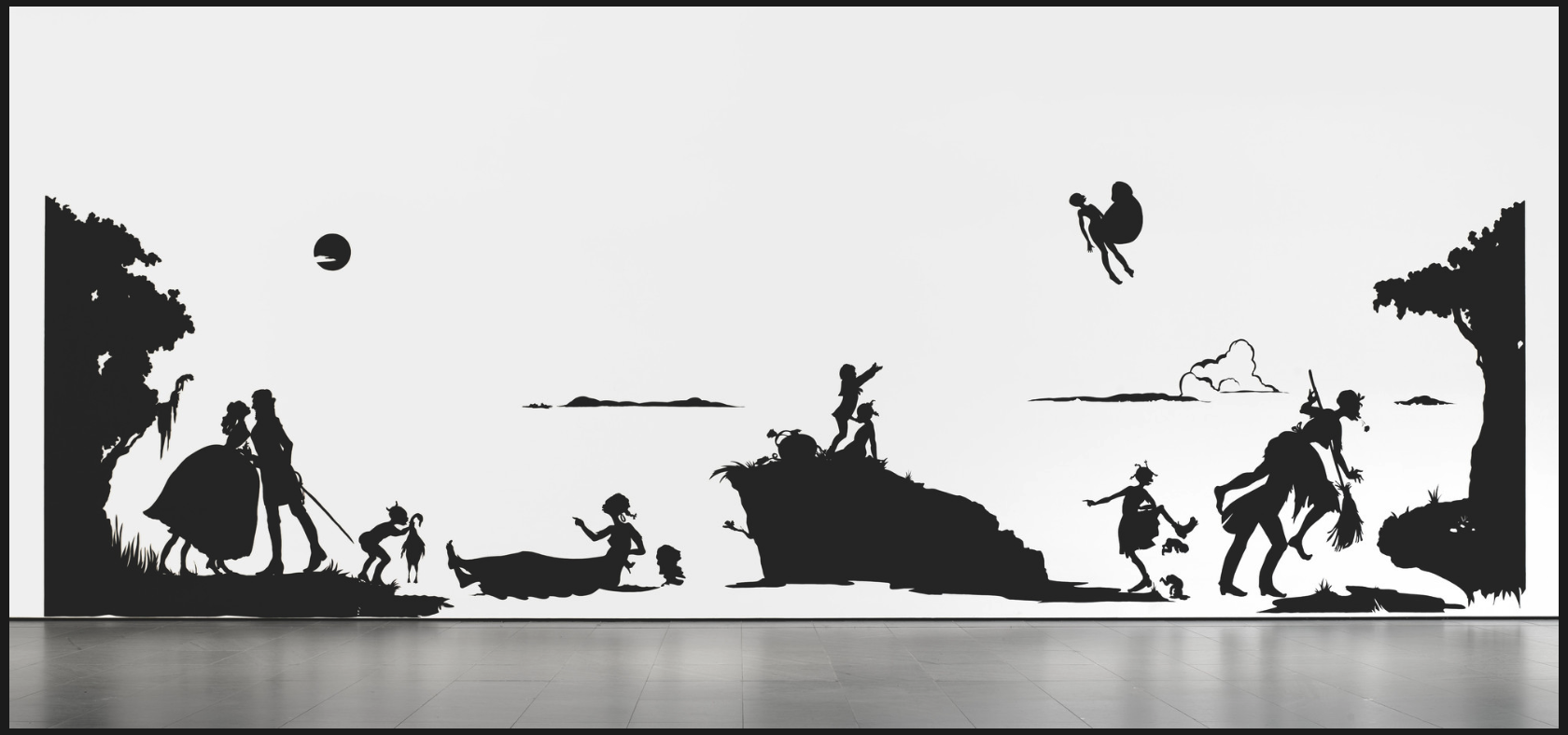
Fig.5. Gone: An Historical Romance of a Civil War as It Occurred b’tween the Dusky Thighs of One Young Negress and Her Heart (1994)
Kara Walker’s practice leverages her personal narrative of being a Female artist of colour with its associated stereotypes to reflect upon and analyse America’s legacy of slavery, racial violence and gender oppression. Works such as “A Subtlety” (2014) and “Gone: An Historical Romance of a Civil War as It Occurred b’tween the Dusky Thighs of One Young Negress and Her Heart” (1994) connects her narrative to the historical and economic systems that perpetuated slavery and racial persist discrimination. This use of personal experience as a lens for analysing cultural phenomena and generating new knowledge about racial hierarchies in contemporary society, validates Walker’s practice as autoethnographic research.
Challenges and Critiques: Rigour and Validity
Autoethnography and practice-based research are criticised for lacking scholarly validity and rigour. Practitioner biases are held to undermine systematic analysis, with subjective experience and aesthetic dimensions compromising traditional knowledge production standards. However, these critiques reflect narrow, institutionalised research concepts that privilege certain forms of knowledge over others.
Autoethnography’s validity stems precisely from elevating subjective experience, revealing knowledge that is not recorded by conventional methods: it exercises “research as a political, socially-just and socially conscious act” (Adams and Holman-Jones, 2008 cited in Adams, Bochner and Ellis, 2011:273). Similarly, artistic practice achieves validity by surfacing insights inaccessible through other methodologies.
Embodied knowledge from artistic practice, cultural critique embedded in aesthetic choices, and reflexive analysis in artist statements constitute legitimate autoethnographic enquiry. Rather than weaknesses, subjectivity and personal experience become strengths that expand our understanding of knowledge production beyond traditional academic boundaries, offering alternative ways of knowing that complement established research methods.
Conclusion
Having discussed parallels between the theoretical foundations, methodologies and practical applications of both autoethnography and contemporary artistic practice, I hope to have demonstrated that a reflexive creative practice is qualifiable as a valid form of autoethnographic research. And by reflecting on how the practices of Marina Abramović and Kara Walker are demonstrably autoethnographic, I hope, by association, to have positioned my own practice as autoethnographic in focus.
Instead of being regarded purely as an act of generating creative artefacts, artistic practice should be appreciated as an opportunity for expanding methods of knowledge production: autoethnography offers a framework for recognising and validating knowledge production, whilst artistic practice offers innovative means for conducting the enquiry. This significantly impacts both fields, expanding our definitions of what constitutes legitimate research methodologies whilst enhancing artistic practice with scholarly frameworks for enquiry.
And by challenging these disciplinary boundaries, by continuing to merge formal autoethnographic methodologies into my artistic practice, I hope to reposition my work as knowledge production that honours the multi-dimensional nature of my lived and the wider human experience.
(1370 words)
Bibliography
Adams, E., Bochner, A., Ellis, C. (2011) ‘Autoethnography: An Overview’ In: Historical Social Research 36 (4) pp.273-290
Barrett, E., and Bolt, B,. (eds) (2010) Practice as Research: Approaches to Creative Arts Enquiry London: I.B.Tauris
Behar, R (1996) The Vulnerable Observer: Anthropology that Breaks your Heart. Boston: Beacon Press
CDM (2016) Marina Abramović: I am neither Serbian nor Montenegrin, I am ex-Yugoslav (Translated) At: https://www.cdm.me/kultura/marina-abramovic-nijesam-ni-srpkinja-ni-crnogorka-ja-sam-eks-jugoslovenka/ (Accessed 28/06/25)
Chang, H (2008) “Chapter3: Autothenography’ In: Autoethnography as Method California: Left Coast Press pp.43-57
Demaria, C (2004) ‘The Performative Body of Marina Abramović. Rerelating (in) Time and Space’ In European Journal of Women’s Studies 11 (3)
Fine, G., Rotheburg, J. (2008) ‘Art Worlds and their Ethnographers’ In: Ethnologie Francaise 38 (1) pp.31-37
Hackett, P., Schwarzenbach, J., Jürgens, U. (2016) ‘Chapter 13: Autoethnography’ In: Consumer Psychology: A Study Guide to Qualitative Research Methods. Germany: Verlag Barbara Budrich pp.97-90.
Hodges, B.D., Kuper, A., Reeves, S., (2008) ‘Qualitative Research: Qualitative Research Methodologies: Ethnography’ In: British Medical Journal 337 (7668) pp.512-514
Marina Abramović Institute (MAI) (2025) About Marina Abramović Institute At: http://mai.art/about (Accessed 15/06/25)
Sullivan, G (2009) Art Practice as Research: Inquiry in Visual Arts (2nd ed.) London: Sage Publications
List of Illustrations
Fig.1. Abramović, M (2010) The Artist is Here [Performance] At: https://www.lissongallery.com/artists/marina-abramovic (Accessed 15/06/25)
Fig.2. Abramović, M (1975) Rhythm O [Performance Photograph] At: https://www.guggenheim.org/artwork/5177 (Accessed 28/06/25)
Fig.3. Whiteread, R (1996) Detail from Rachel Whiteread Untitled (Vienna) 1996 Sketchbook At: https://www.countereditions.com/rachel-whiteread-limited-edition-print-1817.html#images-5 (Accessed 28/06/25)
Fig.4. Walker, K. (2014) A Subtlety [Sculpture] At: https://artsandculture.google.com/asset/a-subtlety-kara-walker/TAEOFCFww_WbDg?hl=en-GB (Accessed 15/06/25)
Fig.5. Walker, K (1994) Gone: An Historical Romance of a Civil War as It Occurred b’tween the Dusky Thighs of One Young Negress and Her Heart At: https://www.moma.org/collection/works/110565 (Accessed 28/06/25)