
Aims
- Begin developing a work with a narrative core, that offers/ documents a perspective on a personal experience
- Begin to explore a way of translating a bodily or emotional experience into a visual representation
- Use a continual exploration of a variety of materials and approaches as a way of planning composition and iterating the representation of the subject
- Curiously pursue opportunities for developing and applying a lexicon of symbols and signs that can be used as a ‘visual shorthand’ to describe my experiences
- Question and deliberate on what the notion of ‘language’ means to me, what it is and how I employ it within my work
Narrative Direction
Sparked by my digital work created in response to a recent therapy session (see ‘Thinking’ https://ideasresearchwriting.nikolashead.co.uk/2025/02/01/creative-work-2025/), I wanted to explore a context in which my pattern of thinking originates, give it a figurative grounding, and begin to tell a visual story of that experience for me.
I have recently discovered the work of Kay Gasei and his ability to deliver a narrative within a very painterly way. His way of working, of planning his larger paintings through continual re-examination of the subjects in sketchbooks and loose sheets, and using digital and collage as vehicles for experimentation has resonated with me.

Fig.1 Cultural Capital: Appetite (2023)

Fig.2. S.O.S (2023)

Fig.3. For the Birds (2024)

Fig.4. The Malaika Fight the Flesh (2023)
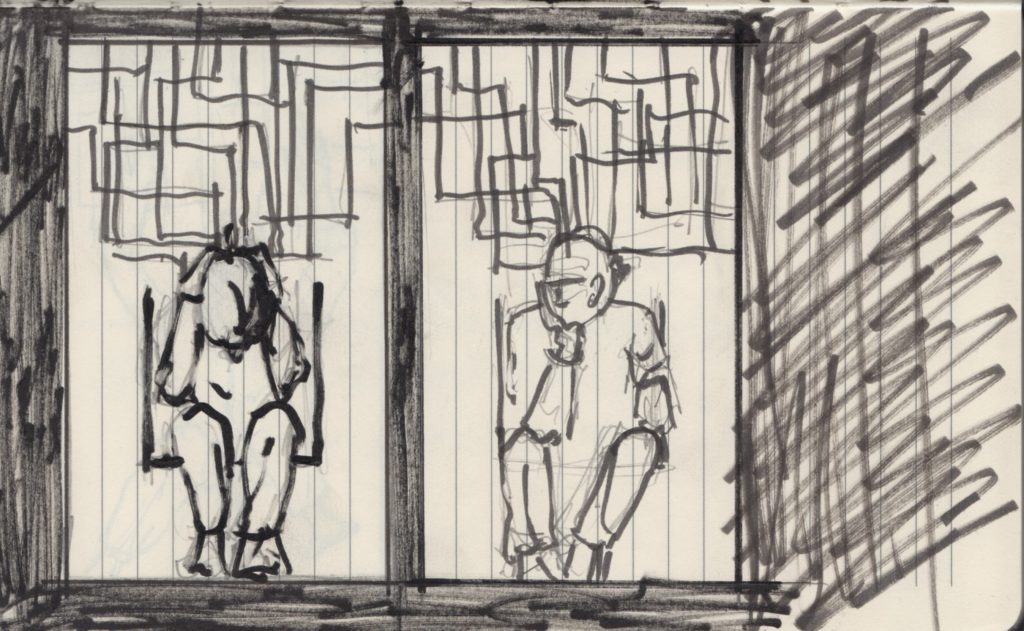
Step 1. Initial idea planning. (Marker on A5 Lined paper)
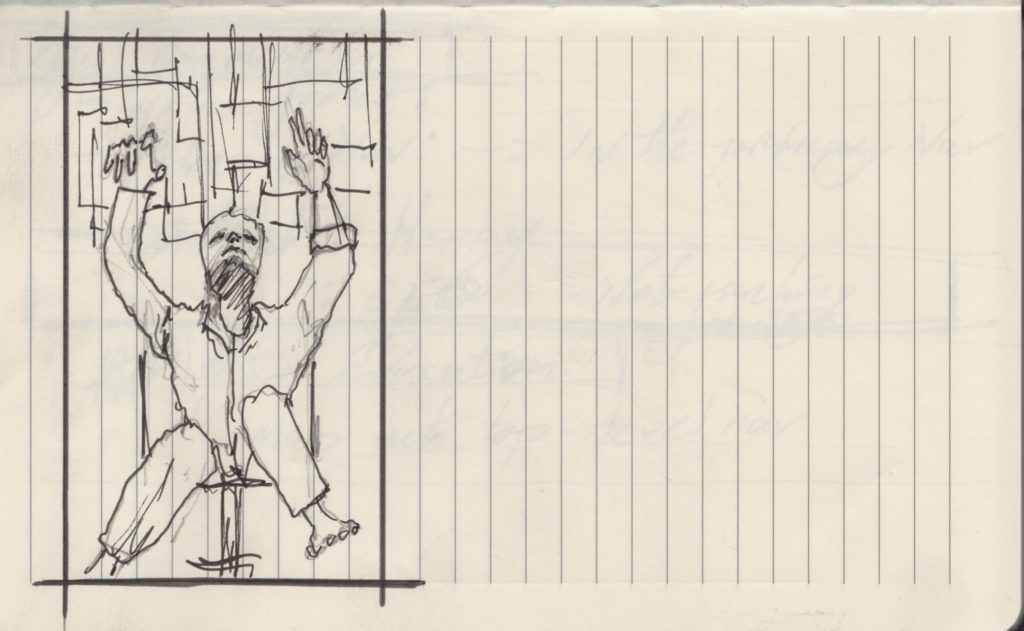
Step 1. Initial idea planning. (Marker on A5 Lined paper)
In these first three quick marker sketches, my aim was purely just to ‘release’ the idea, begin a process of action: I know that if I sit and mull on an idea it never tangibly surfaces, eventually fading into obscurity. The only initial concerns I had with these sketches was the stance of the figure, its scale and a sense of the relationship to the representation of my process of thinking.
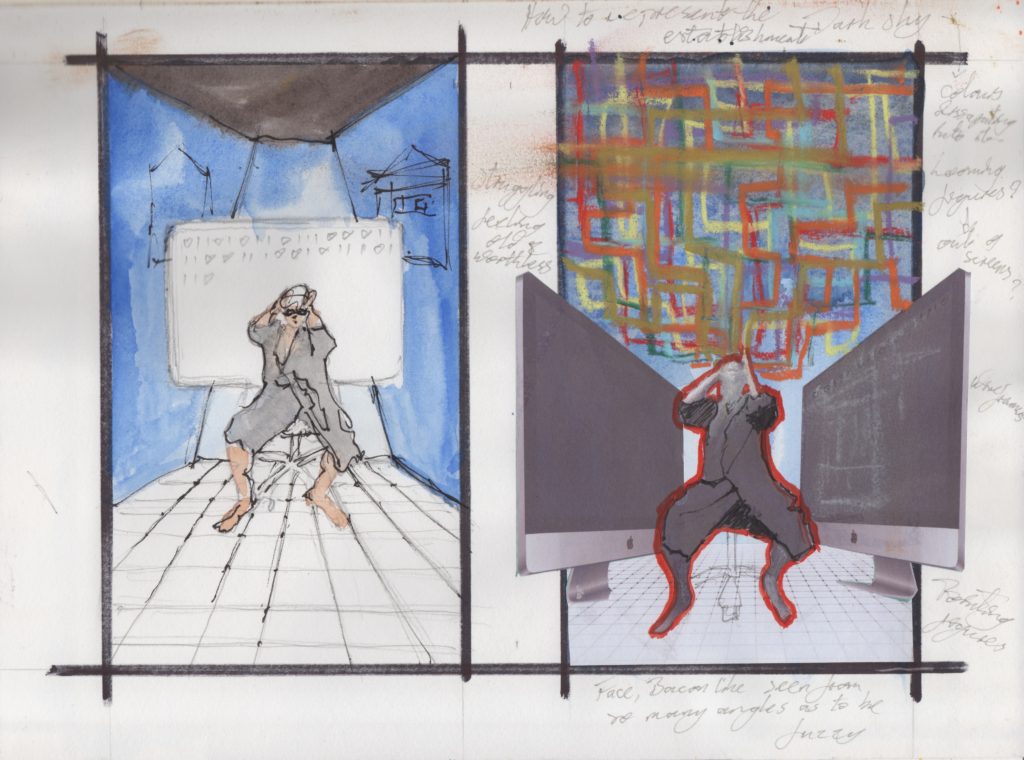
Step 2. Quick idea storyboards (Marker, watercolour, collage and soft pastel on A5 panels in A4 sketchbook)
I find once that initial idea has been ‘released’ onto paper in some form, then ideas and concerns about other constituent dimensions start to surface. What began with the concept of simply representing me and my way of thinking, began to encapsulate the need to explain a cause for that thinking. On an almost daily basis in my professional life, I am casually exposed to a lot of complex technical information, information that I don’t understand and is not really relevant to me. Where that information is relevant, I often have to ‘fight’ to have it distilled or translated into terms that are meaningful to me, because of others expectations that I just understand. This is all exacerbated by the remote working, meetings conducted over Zoom. This seems to engender a detachment from people that affects the way that they communicate: they also feel less corporeal, just distant digital entities, ‘ghosts in a machine’.
These next steps, see me grappling with how to represent those factors, the digital detachment, the overwhelm of information from digital ghosts, my inability and lack of desire to understand the information being exposed to me, my frustration at having the argue for translation, the depth of the confusion I feel. There is another aspect of this experience for me, not represented in these explorations, to be ‘released’ elsewhere, is the way that I then detach from what is happening, I shut down and seek distractions elsewhere.
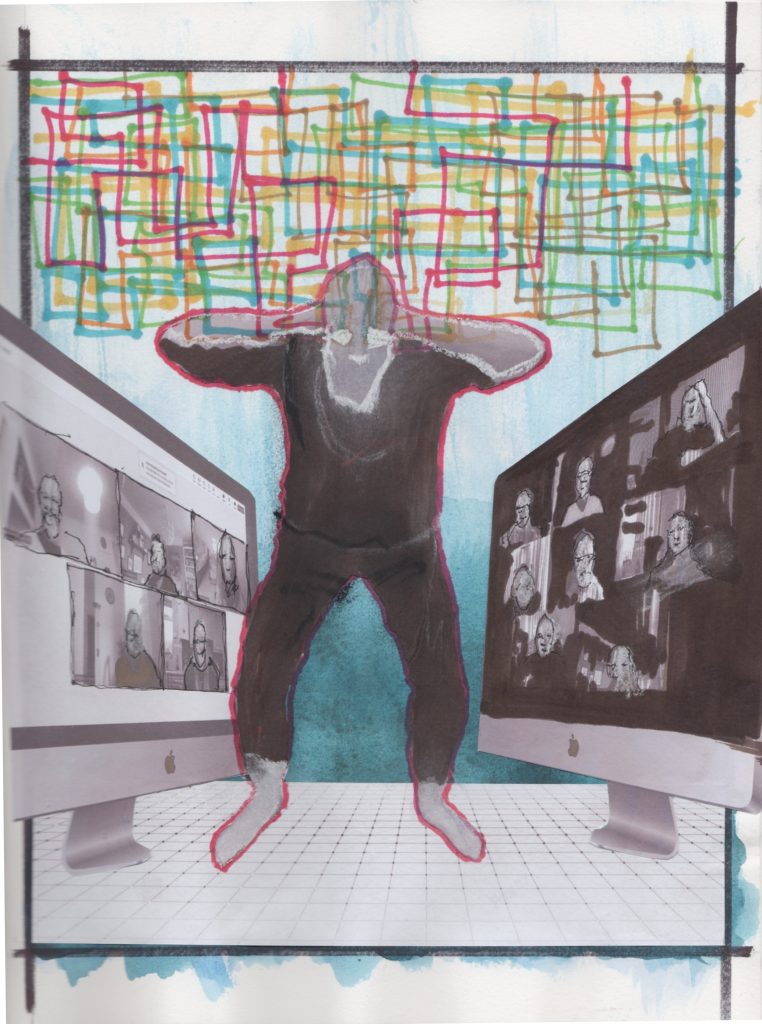
Step 3. More refined idea storyboard (Marker, watercolour, collage and soft pastel on panels in A4 sketchbook)
The sketches shown in step 2, contemplate me as a seated figure. I felt this was too passive, though it is reflective of how I am physically positioned during those aforementioned work meetings. My frustration is an emotion that tends to get tamped down during these meetings: it’s a common topic of enquiry at my therapy sessions why I don’t find a way to physically move to release certain stuck energies when they arise, why I sit in them and allow them to ‘fester’. By centering the composition around a standing figure in step 3, I wanted to suggest an active movement that is aiding the release of the frustration-laden thought process.
I also introduced visual references to the causes of my frustration, my colleagues on Zoom. I had in my head the vague influence of the raked rows of seats of the Roman Senate, with these screens and figures being a modern interpretation of that. Collaging elements allowed me to consider these aspects quickly, without the labour of drawing or painting them each time. This faster experimentation helped me understand the uncomfortable disjoint in scale between the central figure and the surrounding computer screens, a dimension reassessed in later sketches.
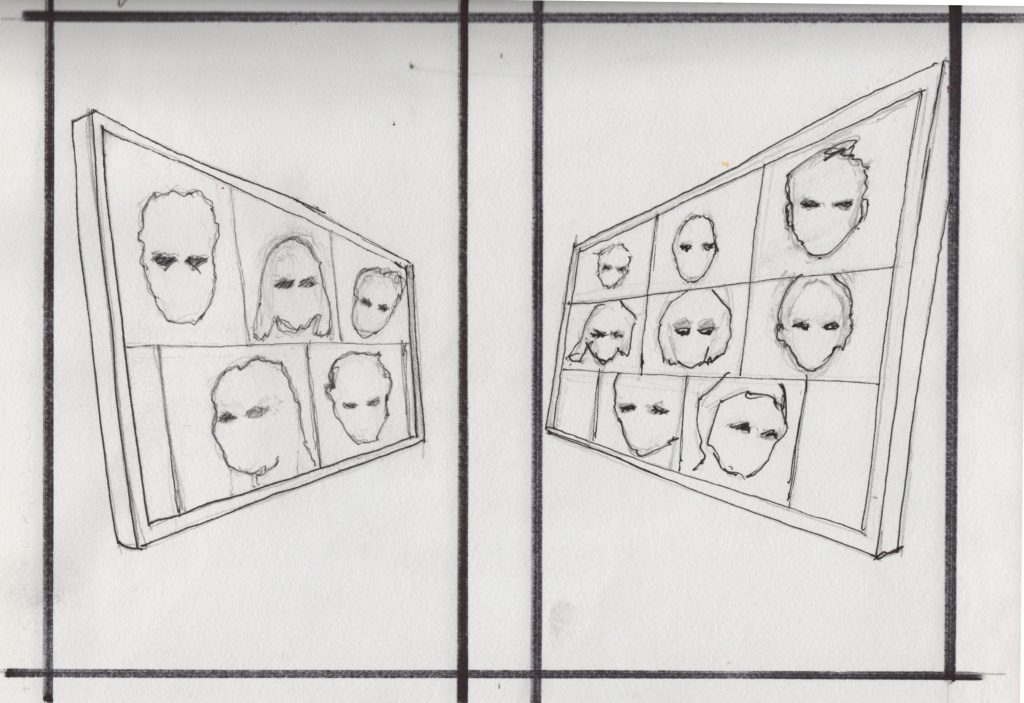
Step 4. Planning specific elements (Marker, and fineliner in A5 panels in A4 sketchbook)
These sketches were always intended as planning strategies for a larger painting and specific elements, that were taking on a more profound presence in the concept, needed more involved examination to allow me a more secure base to create from in the main work. The computer screens needed this exploration, especially the vision I had was to reduce them to the essentiality of line. Practically speaking, I am not especially good at freehand straightlines, so these sketches are practises at that. They were also an exploration of how to visualise the ‘ghosts in the machine’, the digital simulacrums of my colleagues that I converse with. They became just the heads, as a reference to the typical Zoom view. The dark, almond-like eyes suggest malevolent entities within the screen: this is a twisting of the truth, my colleagues are not malevolent! Indirectly I am referring to how modern tech and digital media is giving rise to mis-and dis-information. More directly I am referring to the insensibility of others to how they are delivering information, and how I would want to receive it.
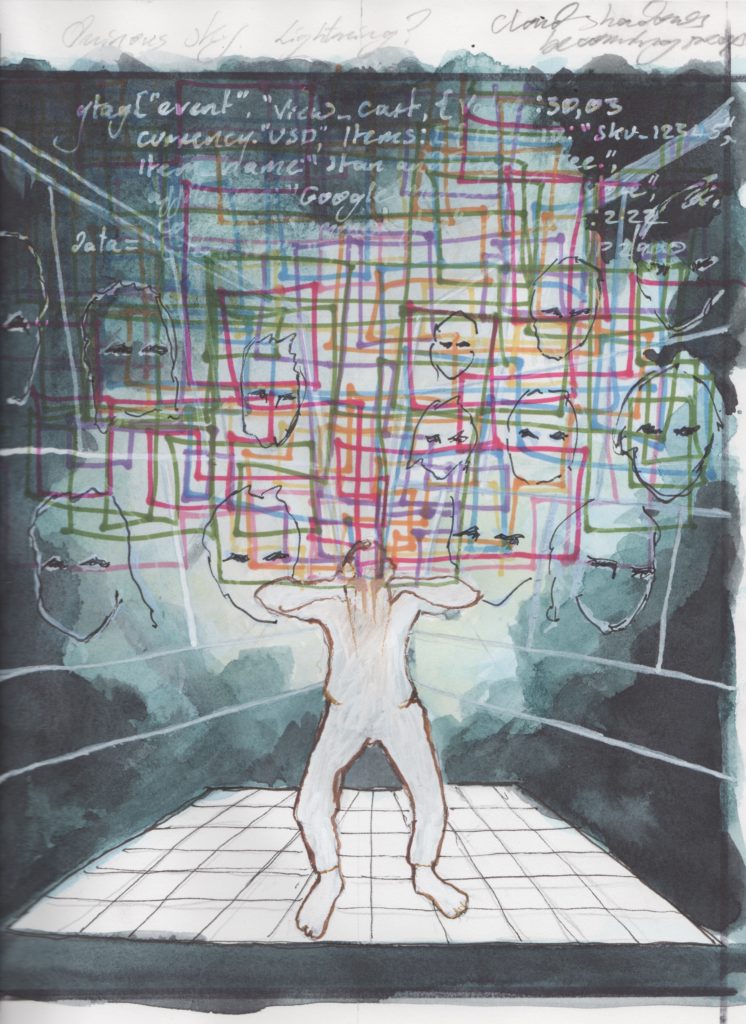
Step 5. Iterating idea variants (Marker, Posca paint pen, watercolour, collage and soft pastel in A4 sketchbook)
Step 5 is trialing an iteration in the scale and relationship of the central figure, the screens and the ‘thinking’. In this sketch, I have also begun to consider the background for the piece: a stormy sky, with a glimpse of light – clouds of judgement, anger -somewhat contrived tropes, but again an idea that needed releasing. Over those angry clouds, I begun playing with layering computer code, again a reflection on the unintelligible information that I am exposed to daily
I also considered the surface the figure stands upon. It’s unstable, not real, part of the digital landscape as that’s a large proportion of my daily world, something that can disappear when the electricity is turned off. Again, a quick sketch to get the idea out of my head.
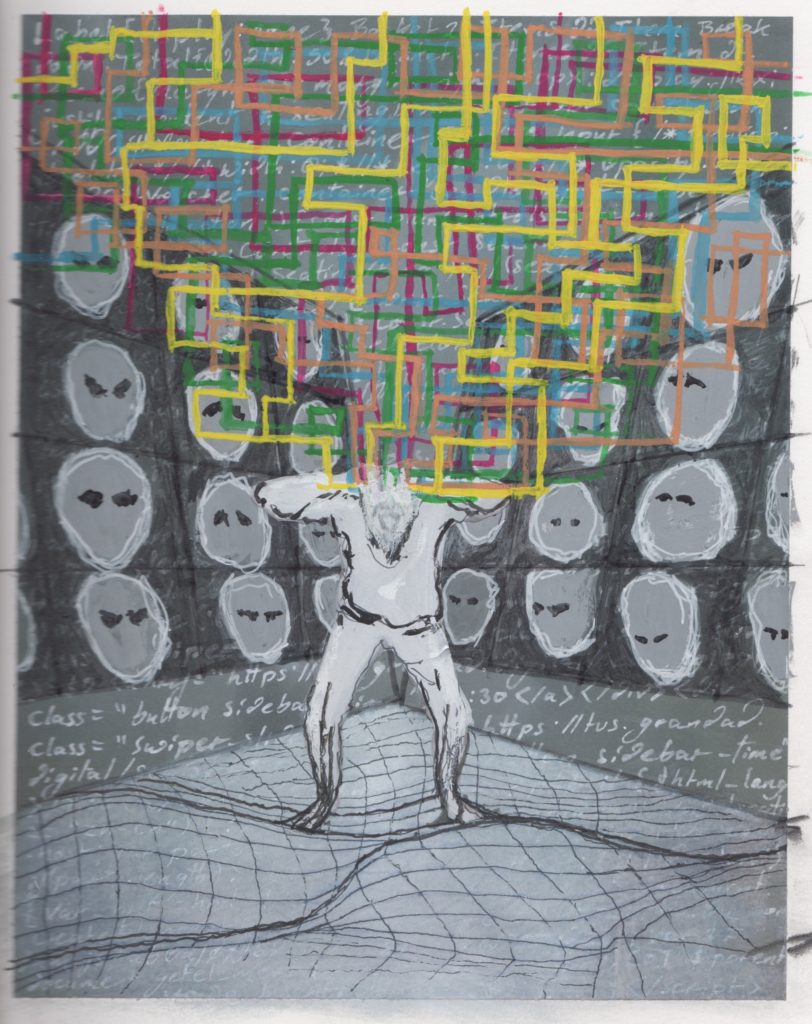
Step 6. Iterating idea variants (Marker, Posca paint pen, watercolour, gouache, and collage in A4 sketchbook)
This last sketch is beginning to become more detailed, and is beginning to solidify the ideas. The scale of the figure in relation to the screens feels more appropriate. The heads are heading towards more ethereal, though more of the background needs to be visible through them.
The background started as a dull printout of an image of the stormy skies, which I then covered from top-to-bottom with lines of random hand written computer code in white acrylic. The floor was created by printing a graphic image of an undulating grid onto OHP film, and whilst the ink was still wet, placing that film onto the sketch and rubbing hard! This was then inked over with a fineliner. In the floor I also played with the idea of beginning to be consumed by the digital environment – the floor beginning to ‘grow’ up the legs of the figure.
The only aspect I am still struggling to define is the ‘thinking’. In this sketch, I executed it in gouache, but the thickness of the lines as a result of that media and the ill-judged layering of colours disconnects it too much from the rest of the composition.
There are further explorations of this idea needed. Most likely scaling it up and working through the idea in paint. At present the A4 scale is restricting my painterliness, and the visuals are stiff, contrived and lack a materiality. Increasing scale and using oil may encourage a more somatic approach to execution, which will lend the image a freedom and fluidity missing from the sketches.
List of Illustrations
Fig.1. Gasei, K (2023) Cultural Capital: Appetite [Mixed Media on Canvas] At: https://www.jacksonsart.com/blog/2024/12/06/artist-insights-kay-gasei/ (Accessed 24/02/25)
Fig.2. Gasei, K (2023) S.O.S, 2023 [Oil, oil pastels and pencils on reverse primed canvas] At: https://www.jacksonsart.com/blog/2024/12/06/artist-insights-kay-gasei/ (Accessed 24/02/25)
Fig.3. Gasei, K (2024) For the Birds [Oil, oil sticks and oil pastel on loose linen] At: https://www.jacksonsart.com/blog/2024/12/06/artist-insights-kay-gasei/ (Accessed 24/02/25)
Fig.4. Gasei, K (2023) The Malaika Fight the Flesh [Oil on Linen] At: https://www.jacksonsart.com/blog/2024/12/06/artist-insights-kay-gasei/ (Accessed 24/02/25)