
Overview
I have taken a deliberate backward step on this project because of what I perceive as a fundamental issue with how it has been shaped.
At the beginning of this projects documentation we are told that we…
“will be reflecting on, researching, writing, having conversations with others, and making work in response to the notion of care“
and…
“to shift your focus, and perspective beyond, and outside of your own individual lived experience, to reflect on local, and global environments, considering the responsibilities and implications of care not solely on individuals, or families, but on communities, environment, organising structures, and systems of government“.
But we are not asked to establish and document our own individual notions of what care means, before we are challenged to think beyond them. We are asked to consider the bigger picture first, how other artists respond to that, whilst lip-service is paid to own understanding: there is a suggestion in the material that our personal perspectives are ‘just there, and that they will ‘come out’ in our work anyway.
It’s also important to me to challenge the project writer’s assertion that we move beyond our own ‘individual lived experience’. I would suggest that many, if not all of the artist’s we are being asked to research are, at the core of their ideas, responding to their lived experience of the themes of their creative discourse: John Akomfrah’s work deals with themes of race, identity and post-colonial attitudes because of his lived experience of being a person of colour: Larrisa Sansour’s work is a response to her lived experience of being a Palestinian woman and the forms of oppression that brings. Shirin Neshat’s work comes directly from a place of her lived experience as a diasporatic Syrian woman, that has experienced the patriarchal oppression of the country of her birth and of western society. Tracey Emin’s work comes from a place of live experience of abortion, rape and lost love. I would suggest that all contemporary artists’ work has a direct relationship in some way to their lived experience!
For work to connect with an audience, to offer a valuable discourse, to be honest, and (much as this word is overused) to be authentic, it must begin from a place of lived experience. Otherwise, work will only ever come from a place of an insincere observer.
I think it is profoundly important that we are formatively asked first how we define ‘care’, what it personally means to us, before we are asked to explore others perspectives. This is an exercise that should be done for all of the relevant projects as it will better help us connect with the material: much of that I have studied so far I have not been able to engage with or be stimulated by, because I have no emotional foundation to connect me to it. I for one, had not rigorously formed my own perspectives and understanding of what ‘care’ means, so when challenged by the academic and intellectual requirements of the exercises in the project, I found myself first, overwhelmed by their demands and secondly by the competing themes and perspectives being surfaced in the required research, none of which are (initially) mine. This detaches the research from ‘me’ as I haven’t been required to determine my own perspective as a counterpoint or a foundation: the material I have been reading doesn’t stimulate a creative response from me, because the ideas belong to others, and I cannot see beyond those. Without formally defining a personal ‘baseline’ of what ‘care’ means to me, I found myself all at sea without a compass in a raging torrent of others’ ideas and output. So, I have stepped back, and have started a process of trying to understand what care means to me.
Initial Mapping
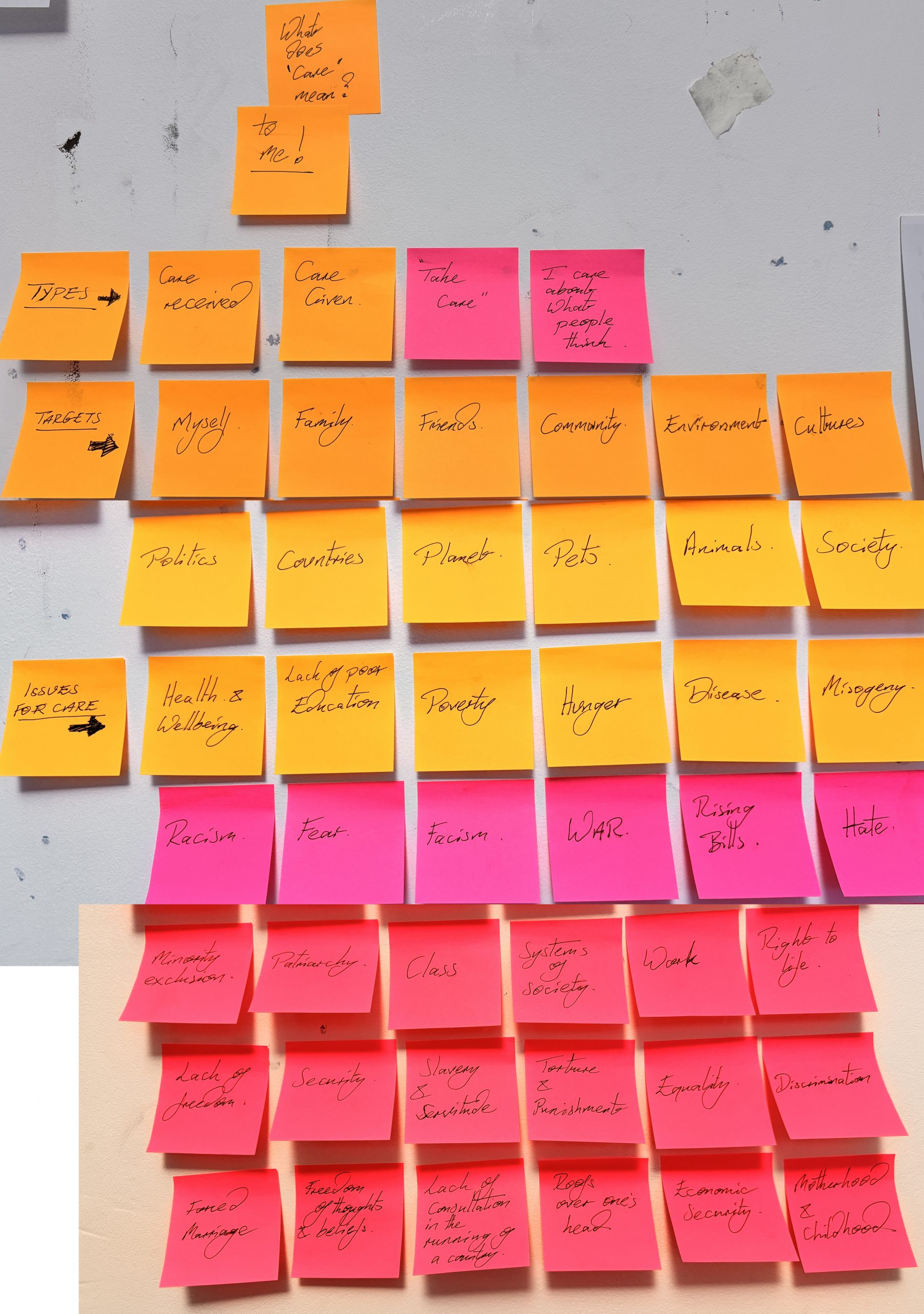
A starting point. What are the types of ‘care’ and who are the targets or recipients of ‘care’. What are the issues that ‘care’ can be employed to tackle, to address’.
Secondary Mapping
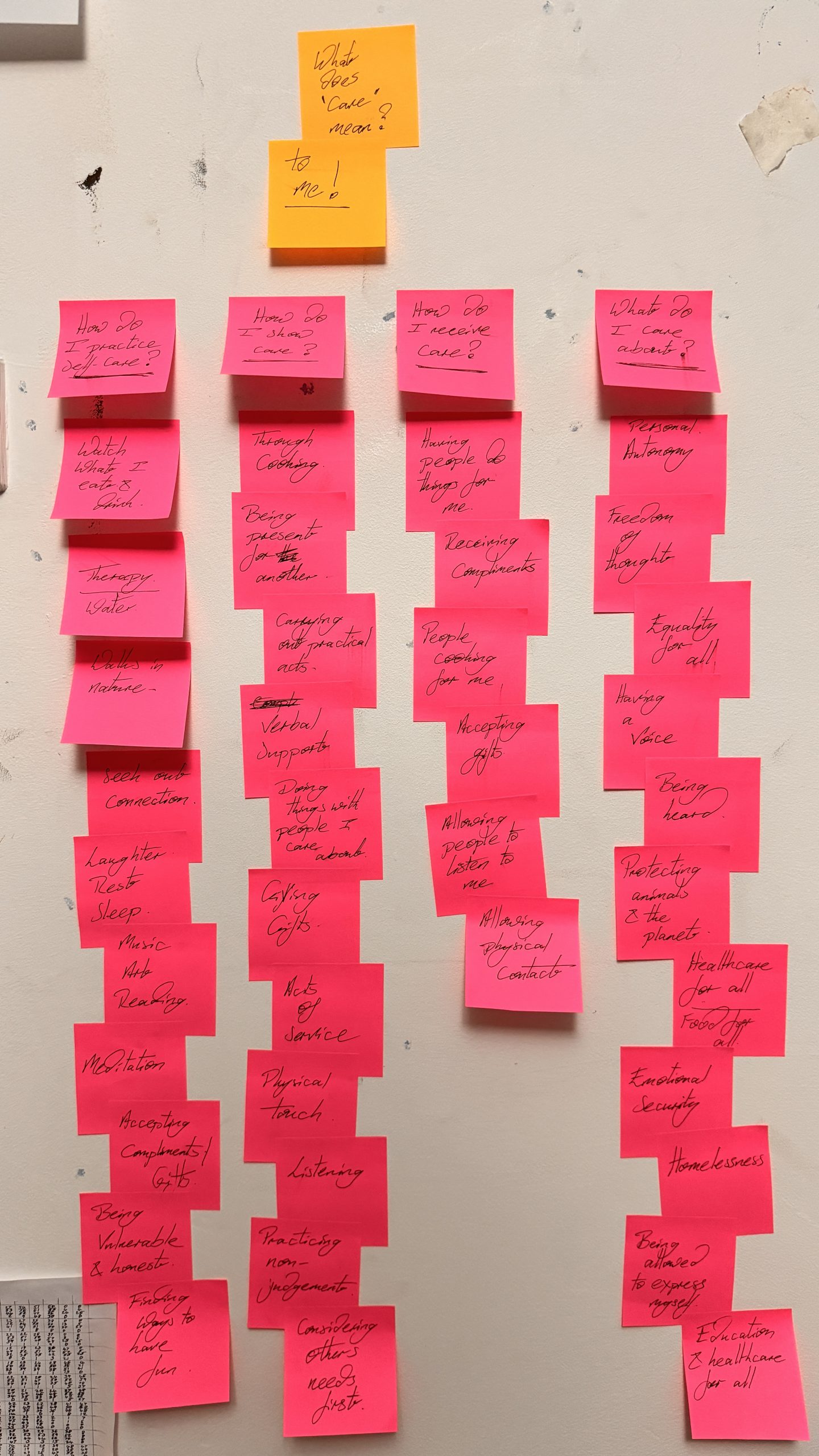
Manifestations of care in my life: How I practice it, how I show it, how I receive it and what I care about.
Dictionary Definitions of Care
Care can refer to a humanitarian organisation, a noun meaning protection or a word meaning watchful attention
To protect someone or something and provide the things they need
https://dictionary.cambridge.org/dictionary/english/care-for
To love someone and feel romantic towards them
https://dictionary.cambridge.org/dictionary/english/care-for
To provide for a person or animal’s needs and to protect that person or animal
https://dictionary.cambridge.org/dictionary/english/care-for
To like something or someone
https://dictionary.cambridge.org/dictionary/english/care-for
activity involved in maintaining something in good working order
https://www.vocabulary.com/dictionary/care
be in charge of, act on, or dispose of
https://www.vocabulary.com/dictionary/care
judiciousness in avoiding harm or danger
https://www.vocabulary.com/dictionary/care
A cause for feeling concern
https://www.vocabulary.com/dictionary/care
An anxious feeling
https://www.vocabulary.com/dictionary/care
To be concerned with
https://www.vocabulary.com/dictionary/care
Feel concern or interest
https://www.vocabulary.com/dictionary/care
Prefer or wish to do something
https://www.vocabulary.com/dictionary/care