
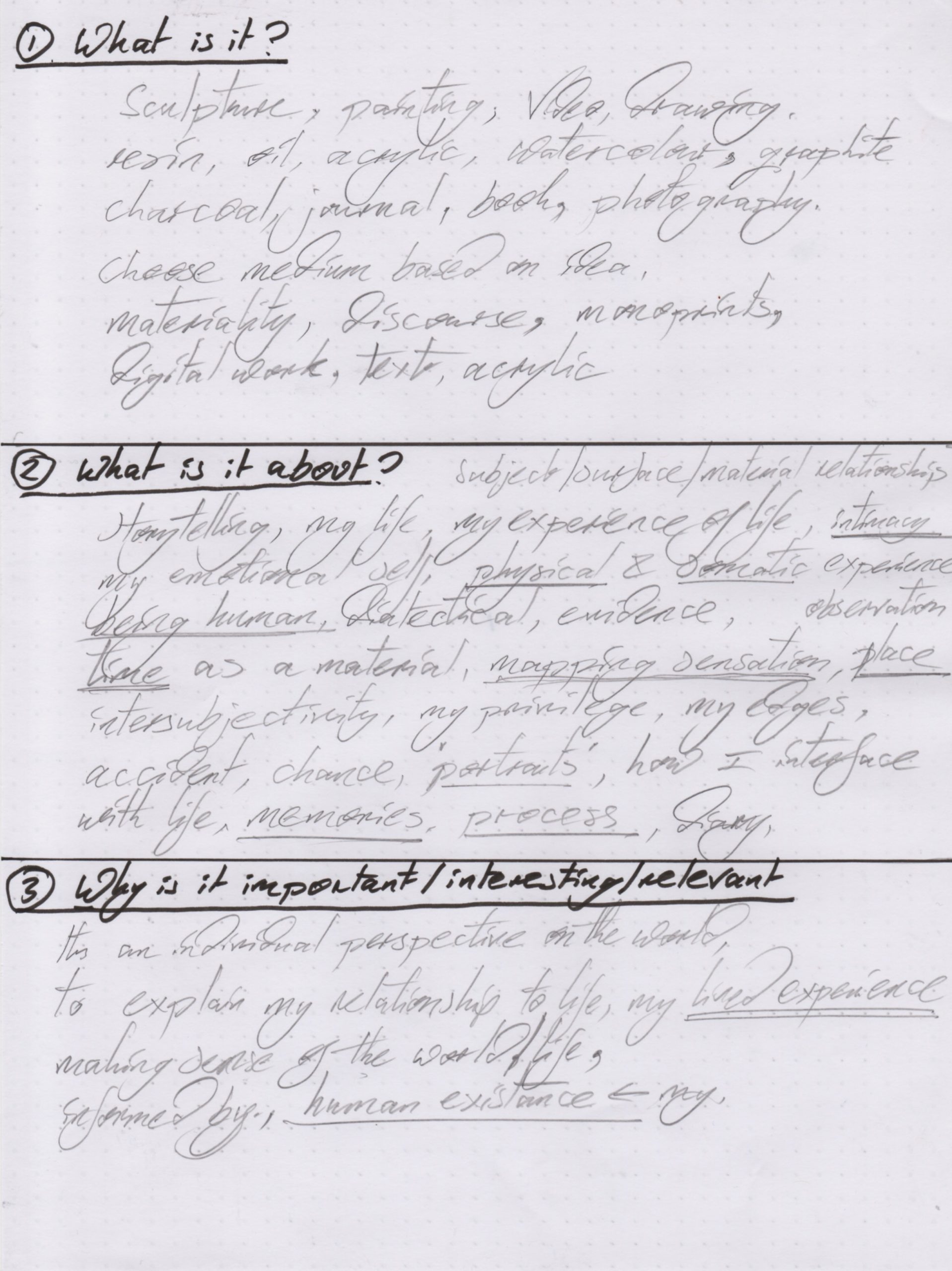
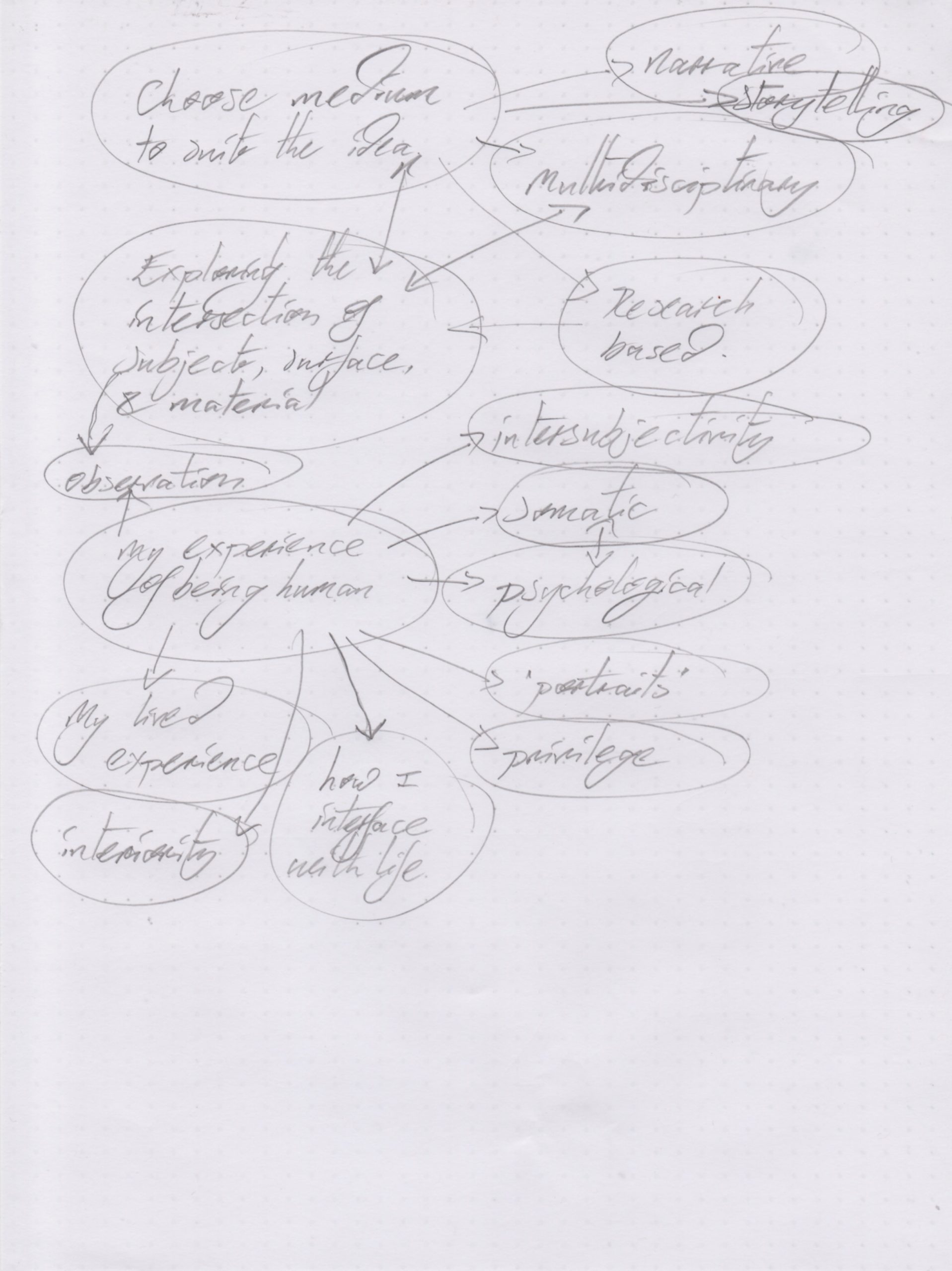
I have returned to this exercise, because having travelled further into the Unit (I have just completed Project 6 at the time of revisiting this), I have more fertile ground on which to base a description of my practice.
Again, I’ll reiterate, it was far too early in my opinion at the end of project 3, to ask students to write even a nascent version of an artists statement. With the beginnings of the unit overwhelmingly focused on written output, and dominated by the research of other artists’ practice, it is very difficult for students to begin to develop a practice that is their own and explicitly independent of the material they are presented with. What if the research subjects and themes didn’t resonate with a student – as many didn’t in my case? Because of the way the Unit material has been structured and written it will almost always elicit a direct response to the exercises in the sense of meeting academic criteria: it won’t necessarily encourage an individual to think critically and practice ‘outside of the box’. Exacerbating this, is the need to research others’ practice without challenging individual students to consider their own opinions and lived experience in relation to a theme first. If you ask me to write or practice around the subject of ‘Confessional Writing’ without asking me to consider what my initial perspective or ideas are on it, what it means to me, I will struggle (as I did) to think beyond the themes and aesthetic of the artists presented to me.
Research/ Thinking
Statement
I am a multidisciplinary artist with a practice focused on representing my somatic and psychological experience of being human, and how I make sense of the world around me. I am not bound to any particular material or way of working: I am interested in discovering how the realisation of my ideas is shaped by the relationship between subject, surface, process and material.
My process beings with research in response to an idea or thought, however small or vague that may be. Through this exploration I tease out the strands of the narrative I am exploring, discarding those that don’t resonate. At each step I am playing with materials and surfaces to examine their affecting interplay with the subject. My process may ‘release’ a ‘final’ piece, but equally, the process of research may be the completed work: I allow my explorations to lead me.
My work serves to invite viewers to contemplate with curiosity and empathy, the moments – both big and small – that form the complexities of their lives. I want them to be mindful of how those moments shape their relationship with the world and how that in turn impacts, both positively and negatively, the lives of others.